

Highest reach
L
Land of Palestine
@landpalestine
“The UN has officially declared Gaza a genocide… Israel is deliberately targeting children and babies.”
3,116,829 imp39,043 RT
Advocacy · compression · view on X
How an institutional finding was amplified and stripped of its caveats until it hardened into settled fact, and how rarely it was questioned.
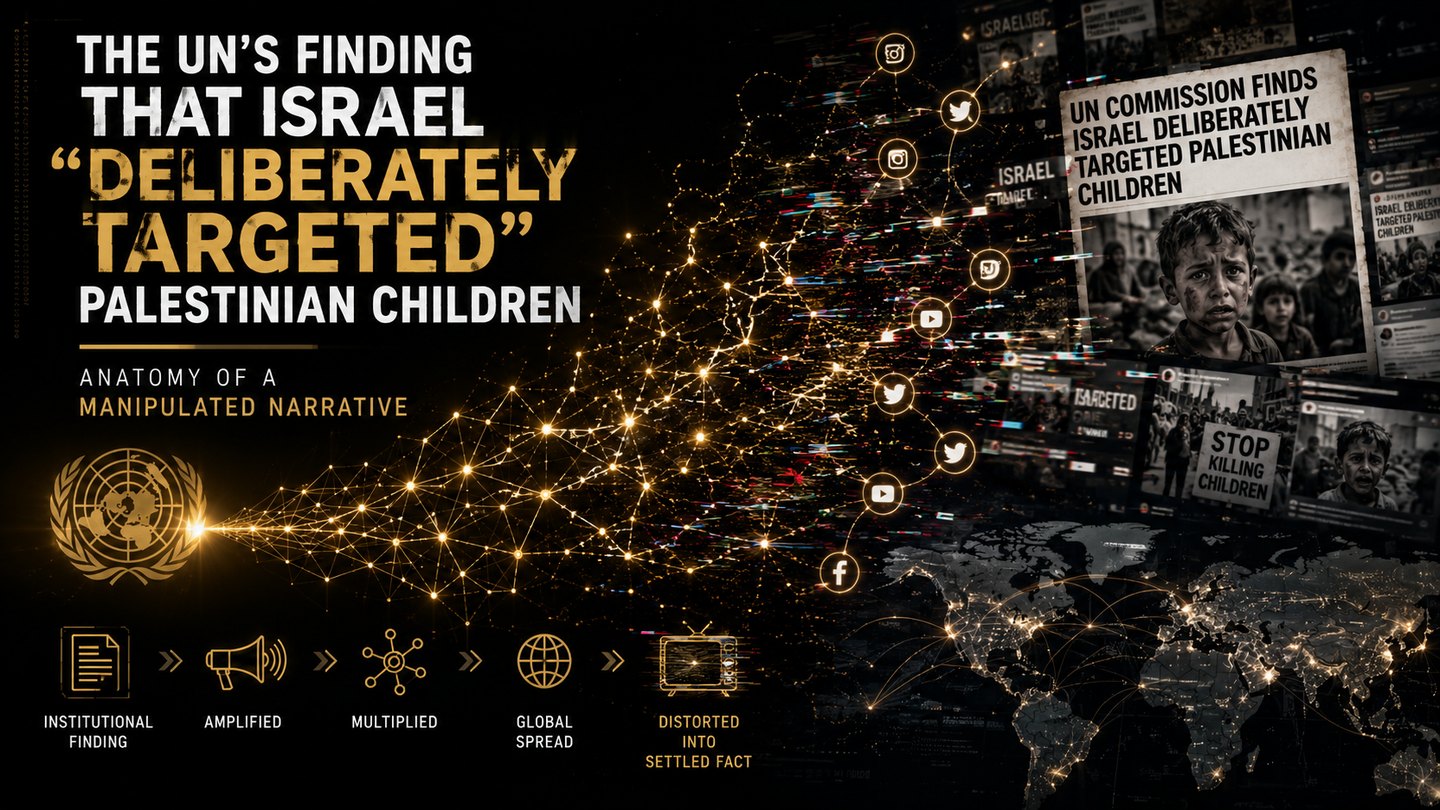
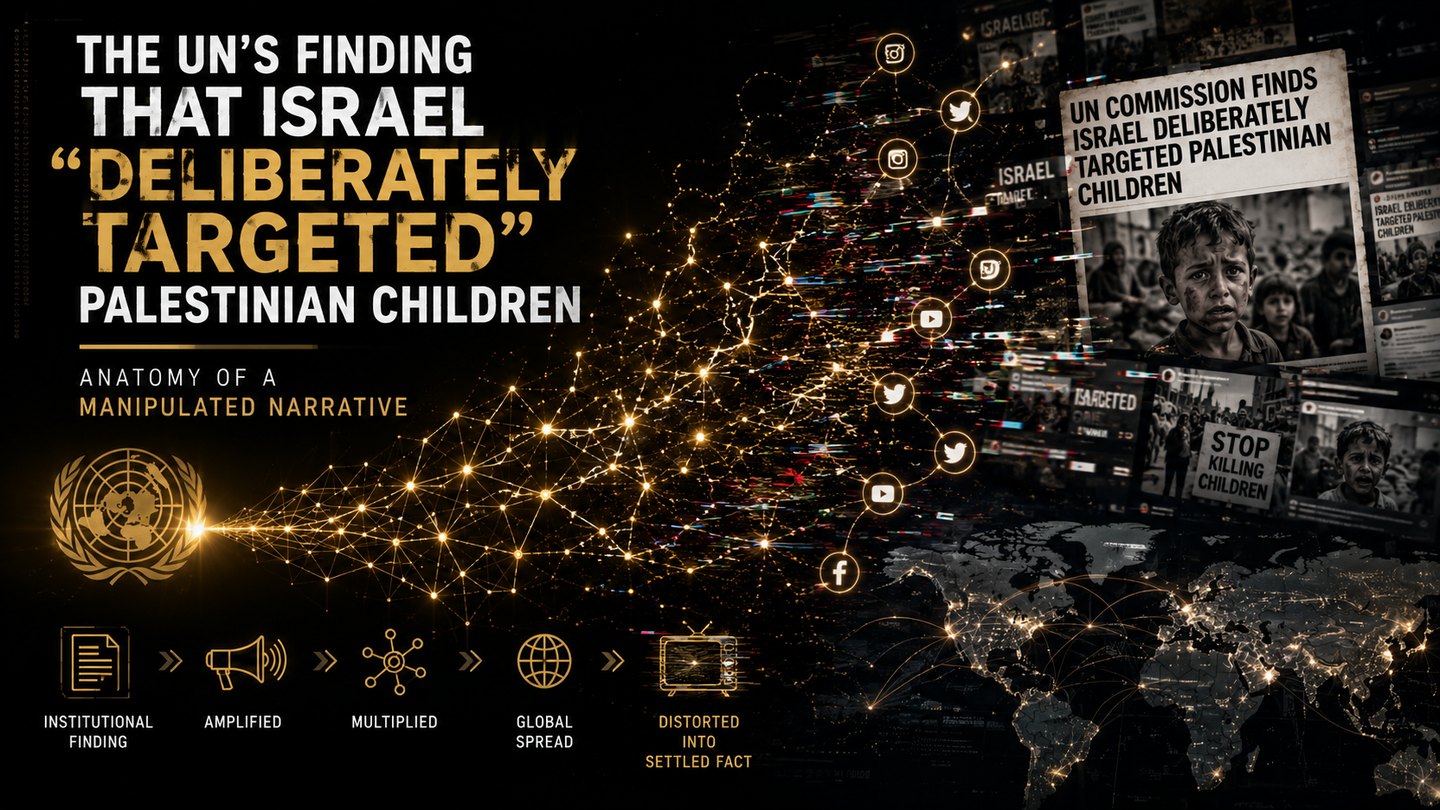
On 23 June 2026 the UN Independent International Commission of Inquiry submitted report A/HRC/62/CRP.2, finding that Israel deliberately targeted Palestinian children. Within hours it saturated the world's news agencies and drove a 389,091-post cascade. This report follows how that finding moved: a modern-day game of “telephone,” in which each retelling multiplied the reach and shed the caveats: a hedged finding (the UN “finds on reasonable grounds” a genocide) hardened into a flat, official-sounding verdict (“the UN officially declared a genocide”) as it passed from one network to the next, repeated as settled fact far more often than it was questioned. Two things here are contested, and I keep them apart: the intent the Commission inferred, and the casualty figures themselves, which are sourced to the Hamas-run Gaza Health Ministry.
 June 27, 2026
A few clarifications on what this is and is not. It does not assert that the Commission's finding is true or false, and it does not adjudicate the underlying conflict. That large numbers of Palestinian children have been killed and injured in Gaza is widely reported, even as the precise figures stay contested (§07). Because the origin is institutional, a standing UN Commission of Inquiry plus mainstream news-agency coverage rather than an anonymous viral seed, I also weigh the source itself: the UN's documented, disproportionate focus on Israel (§03) shapes how any single output should be read. On method: the figures are platform-reported, drawn from commercial social-media monitoring; superlatives are bounded to the record reviewed; and the corpus is a partial sample that under-captures video platforms and speech inside videos (the tip of the iceberg, see §10).
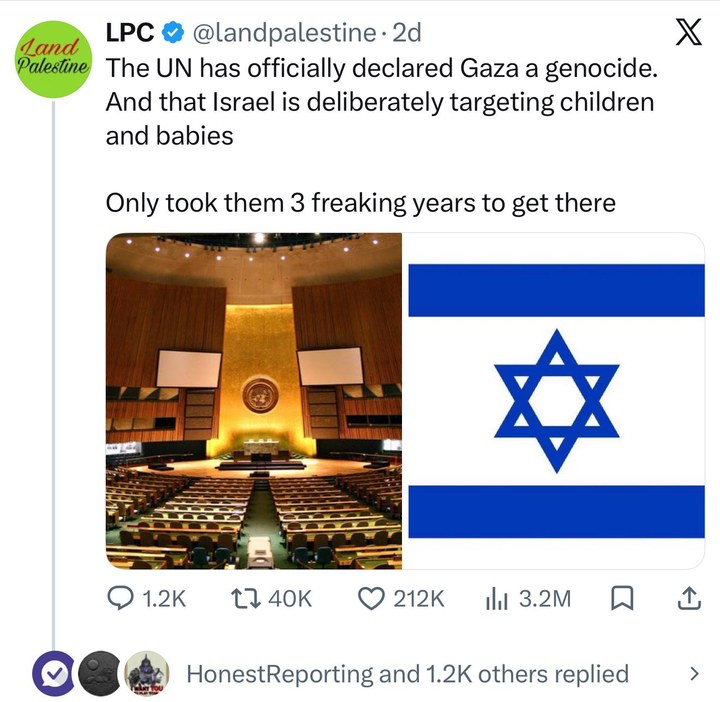 Most-amplified post in the record · view on X
See who is behind it, and how the wording escalated
Most-amplified post in the record · view on X
See who is behind it, and how the wording escalated
This report does not rule on whether Israel deliberately targeted children. That question is contested, and so are the casualty figures (sourced to the Hamas-run Gaza Health Ministry). What I document is how the narrative was built, moved and amplified. The deeper, more technical analysis follows below.
What was found, how it moved, and what is actually contested
On 23 June 2026, the UN Independent International Commission of Inquiry on the Occupied Palestinian Territory (the “Pillay Commission,” after former chair Navi Pillay; current chair Srinivasan Muralidhar) submitted a conference-room paper, “The essence of childhood has been destroyed” (A/HRC/62/CRP.2), finding that Israel deliberately targeted Palestinian children, framed as an element of genocidal intent. Within hours, Reuters, the BBC, the Washington Post, CNN, Al Jazeera and others carried it, and it drove a high-velocity social cascade: 389,091 posts and ~3.72M engagements over 21–27 June, peaking at 6,130 posts/hour roughly a day after release.
The structure is not a claim climbing from obscurity toward credibility, it is the inverse: an institutional finding radiating outward, gaining reach and losing nuance at every hop. As it traveled, its most-amplified social forms compressed and escalated the Commission's careful wording. The single most-shared post in the record restated the finding as “the UN has officially declared Gaza a genocide”, a characterization the Commission's report does not make, and it came from an opaque, five-month-old account rather than a newsroom (§02). The cascade was strikingly one-directional: of the ranked posts I examined, ~97.6% asserted or escalated the claim and only ~2.4% raised any question. The accounts driving it are real, established profiles across the ideological spectrum (§05), and a recurring core had pushed an earlier anti-Israel accusation too.
A single institutional origin, a UN Commission of Inquiry report plus same-day news-agency coverage, propagated into a fast, organic, and radically asymmetric cascade. The load-bearing, contested element is intent; as it traveled, the report's hedged “finds on reasonable grounds” wording was stripped to a bare, settled “genocide” and then an “officially declared” verdict, and accepted as settled fact far more often than it was questioned.
Per the Commission: 20,179 children killed and 44,143 injured (7 Oct 2023–31 Mar 2026; ~30% of the dead are children), plus sexual violence and harm to neonatal care. Widely relayed, but the figures are sourced to the Hamas-run Gaza Health Ministry and their reliability is itself disputed (judged broadly reliable by LSHTM and HRW; challenged as inflated by others). A sourcing dispute.
The word “deliberately” converts a casualty toll into a finding of specific intent, that children were targeted as such, as an element of genocidal intent. This is the Commission's investigative inference and the element the counter-voices most dispute (§12). I trace its propagation; I do not adjudicate it.
The single most-amplified post did not come from a newsroom. It came from a brand-new, region-masked, donation-funded account
The post that did the most propagation work in the captured record is below. It sits downstream of the news agencies and the Commission, but it is where the finding's precise language compressed into its most-shared social form, and added a claim the report does not make. What makes it a case study is the account behind it, every metric below is verifiable, and clickable.
Cascade · compression · 3.2M views · view on X
Account metadata verified via commercial social-media monitoring, 27 Jun 2026.
The feed is uniformly anti-Israel, and parts of it meet widely-cited definitions of antisemitism (Nazi and Holocaust comparisons; conspiracy theories assigning collective blame). In the account's own words, each one clickable:
One number stands out. The post earned a 6.8% like-rate (211,289 likes on 3.1M impressions), about six times Reuters's 1.1% on comparable reach. Emotive advocacy naturally out-engages a neutral news post, which is part of why the loud version wins, but a rate this high on an opaque, five-month-old account is also a textbook authenticity flag. I flag it; I do not claim to have proven inauthentic boosting.
This is not a claim about the people who reshared the post. I did not test the resharing audience for authenticity, and I make no allegation that they were bots or coordinated. The concern is the source: the single biggest amplifier of the cascade's most-distorted framing is an opaque, brand-new, paid-verified, donation-funded account that X cannot place beyond “West Asia,” banned from another platform days earlier, whose feed trades in antisemitic tropes. I do not claim a specific government runs it, and that is exactly the point: it is unaccountable. On the evidence, this is not a narrator that should be setting the global frame, yet it did. It is a clear example of how anonymous, biased accounts can steer a narrative (§05, §11).
A timestamped, function-labeled ignition sequence, with the institutional origin noted honestly
The originating publisher is the UN Commission of Inquiry itself: report A/HRC/62/CRP.2, submitted to the Human Rights Council on 23 June 2026, with an OHCHR press release and a Geneva press conference. This is the structural inverse of an anonymous-seed cascade, the origin is an evidence-reviewing institution, and Western virality runs downstream of it. The sequence below labels each step by its function.
Narrative intelligence doesn't only weigh the spreaders, it weighs the source, and here I keep two things apart. That the UN has a disproportionate focus on Israel is an objective, documented fact, the tallies and structure below. Whether that focus amounts to bias is a characterization, but not only Israel's: it is drawn by pro-Israel monitors and Israel itself, and, on the selectivity, by a UN Secretary-General and EU governments. None of it proves or disproves a single line of the report; it establishes why the report's output should be read with the same scrutiny I apply downstream, for missing context, selective sourcing and exaggeration.
Pro-Israel monitors (UN Watch, the World Jewish Congress), Israel itself, and, on the selectivity point, a UN Secretary-General and EU member states read this pattern as structural anti-Israel, and at times antisemitic, bias: a body that disproportionately scrutinises one state while sparing far deadlier conflicts.
Palestinian rights groups (Al-Haq, Addameer) and the Commission itself argue the focus reflects a uniquely protracted occupation, that sustained scrutiny is warranted, and that bias accusations are an attempt to discredit the messenger. Pillay denied bias.
This does not make any specific finding in the report true or false. It means the report arrives from a source with a documented, disproportionate focus on one country, so its output warrants the same critical reading this report applies to the amplifiers downstream: watch for missing context, selective sourcing, and exaggeration. A claim can be partly true and still be stripped of context, weakly sourced, or inflated for effect.
Sources: UN Watch (UNGA tallies) · Times of Israel · World Jewish Congress (Item 7) · commissioners' 2025 resignations. Figures are widely-cited monitor tallies; the bias interpretation is attributed, not SGI's own conclusion.
Hourly volume across the window, and how the claim shed its caveats and hardened hop by hop
The most revealing pattern is not the volume, it is the language. The word “genocide” is the Commission's own conclusion, so the escalation here is not the word appearing, it is the loss of everything around it: the “on reasonable grounds” qualifier, the “an inquiry said” attribution, and the status of a finding rather than a verdict. Counting phrasing across the platform, the report's careful, hedged wording barely traveled, while the bare, certainty-stripped version outran it by ~67×. The claim got louder and more certain, not more precise, as it moved.
Low, steady volume before publication. The topic is live but not spiking.
Reuters and the BBC carry the headline within the hour, with the “deliberately / genocide” framing attributed and intact.
Commentariat compression (“officially declared genocide,” “genocide zone,” “indisputable evidence”) compounds the news-agency coverage to the highest hourly volume in the record.
Volume decays toward the pre-release baseline. The maximalist framings, not the report's hedged wording, are what persist.
One phrase carries the whole shift. “Officially declared,” the jump from the report's hedged finding to a flat, settled verdict, is not just one account's word choice, it is a phrase with a traceable birthday. Across the monitored record the construction “officially declared … genocide” was absent on the day the report was released (23 Jun), appeared the next day, spiked on 25 Jun, and faded within about 48 hours: a seed-and-spread signature, not language that was always in the air.
The @landpalestine post is the clearest origin point: its exact text was copy-pasted verbatim by a string of downstream accounts (LevantWire, IRAN_Global, TNT_Today and others, word for word), and the fact-checks were posted as direct replies to it (“@landpalestine the UN has NOT officially declared…”). The one larger mutation, GBC_Press's “genocide zone,” is itself a rewrite of this same line.
Honest caveat: “officially declared” is a generic phrase, and a few low-reach uses and skeptic rebuttals predate or parallel the post, so this is the dominant super-spreader of the rumor by reach and verbatim copying, not provably its first-ever utterance. Phrase trace via commercial social-media monitoring.
Node size = reach. Lanes run Source News Advocacy Aggregators State-aligned media Rebuttal. Israel's own sources sit in Rebuttal; State-aligned media is foreign (Qatar, Turkey, Iran, Russia, Palestinian).
Grouping the top amplifiers by their lane shows where the reach actually concentrated, and how lopsided the contest was. The news-agency and advocacy lanes dominate; the counter-voice lane is a sliver.
This was not a fresh crowd. At least nine of the accounts amplifying this UN-finding cascade also drove SGI's earlier, unrelated dog-rape accusation against Israel, confirmed by cross-referencing both captured datasets (the true overlap is likely larger; this counts only accounts caught in the partial X capture). The pattern is the same actors mobilising on successive anti-Israel narratives, whatever the subject. Pattern-only · an observable recurrence, not a claim of payment or central coordination.
Each hop measured against the report's actual text, faithful, overstated, invented, or grounded
The entire genocide finding rests on one phrase: “on reasonable grounds” (¶331). That is the standard every UN Commission of Inquiry uses, a finding is made when a reasonable, prudent observer would have grounds to believe the conduct occurred, based on a verified body of evidence. It sits below a criminal court's “beyond reasonable doubt” (roughly the threshold the ICC uses to issue an arrest warrant) and well above mere assertion. So the finding is serious and methodical, but it is not a binding legal determination that genocide happened. That takes a court, the ICJ for a state and the ICC for individuals, and the relevant case, South Africa v. Israel, is still pending. The harm in the cascade comes from collapsing that gap: a documented-but-unadjudicated finding gets run as a settled, “officially declared” verdict, and that carries real damage well before any court has ruled.
With the source text in hand (above), I can rank the highest-reach posts by how far each travels from it. Each rung keeps the previous claim and adds something, a dropped qualifier, an invented phrase, a sharper specificity, and every rung is tagged vs the report: faithful overstated invented grounded. None of this proves the finding true or false; it shows how an institutional finding mutates to fit the narrative as it travels, the “telephone game” in action. One point that trips people up: “genocide” is the Commission's own conclusion (¶331/¶338), so a news agency reporting it with attribution stays faithful. The overstatement comes later, when the attribution and the “on reasonable grounds” qualifier drop and a Commission finding is inflated into an “officially declared” verdict.
The overstated rung, “officially declared,” did not just appear here: it was seeded by a single post and traced hour by hour in §04.
The most-visible skeptical post carried Israel's rejection. It was seen, but barely embraced: high impressions, almost no likes, a fraction of the amplification the claim received.
Read carefully. As the finding climbs the ladder, reach multiplies while the evidentiary basis stays what the Commission documented, the downstream rungs add amplification and compression, not new substantiation. The recurring effect is escalation: the specific finding (“deliberate targeting of children,” within a documented casualty record) is repeatedly restated as the maximal shorthand (“genocide officially declared”), which is the form that travels fastest and that the counter-voices most often attack.
The casualty record, held separate from the contested finding of intent
A sourcing dispute over the count, distinct from, and in addition to, the dispute over intent.
The finding that this documented harm was deliberate, that children were targeted as such, as an element of genocidal intent, is the Commission's investigative conclusion and the element the counter-voices dispute (§12). Their characterizations range from “without a shred of evidence” to “biased and defamatory.”
This report does not establish the intent finding as true or false; it documents the propagation and the contestation of that specific element.
A notable feature of the cycle was a live argument over whether the evidence exists. Skeptics (e.g. a widely-shared Spectator line) argued “the evidence simply isn't there.” But the report itself runs to 94 pages of forensic and testimonial material held to a “reasonable grounds” standard (see the primary-source panel in §06). So the honest dispute is not the existence of evidence. It is the sufficiency and interpretation of that evidence for the intent finding, and the sourcing of the casualty count. I present both sides without adjudicating.
Existence is not the same as quality. Evidence still has to be scrutinized, not blindly accepted: who are the doctors and witnesses, and how were they selected; are the online videos authentic, representative, or staged; and how independent are the sources. Much of the record traces back to the Gaza Health Ministry, partisan outlets (Israel's own left-leaning Haaretz among them), advocacy-aligned forensic groups, Telegram channels and anonymous testimony. None of that makes a finding false, but accepting any source's evidence at face value is neither fair nor scientific.
Presented even-handedly. SGI does not assert which side is correct; the casualty figures are widely reported but contested as to sourcing (Gaza Health Ministry), and intent is the most contested element.
Categorised by function in the propagation chain, ties stated neutrally and attributed
Standing CoI on the OPT (the “Pillay Commission”); current chair Srinivasan Muralidhar, former chair Navi Pillay. Author of A/HRC/62/CRP.2.
Issued the accompanying press release and hosted the Geneva presser; the Commission's institutional vehicle and a top-reach amplifier in its own right.
Carried the finding within the hour with attributed, accurate wording, the high-water mark of careful framing and, by reach, the largest single lane (§05).
Highest-engagement amplifiers outside the news agencies; the lane where compression and escalation concentrated. Drop Site News also drove the earlier dog-rape accusation (§05).
Breaking-news aggregators that maximise reach and reframe for virality (“genocide zone”). MarioNawfal is a also amplified the earlier dog-rape accusation (§05).
Principal NGO-tier rebuttals (legal analysis; process critique). Detailed in §12. Both are advocacy organizations critical of UN human-rights mechanisms on Israel.
Trailing maximalist amplification and reverse-amplification; alignments noted in §11 as attributed characterizations.
Ranked by impressions (aggregated per author), and the share of posts that asserted vs questioned
Across the ranked posts, almost everything asserted or intensified the claim and almost nothing questioned it: explicit skepticism is a rounding error at 2.4%. What dominates is the blunt, unqualified phrasing, “deliberately targeted” (83.5%) and a bare “genocide” (59%), while the report's own exact, hedged wording appears in barely 1.5%. The qualifiers stripped out upstream are precisely what is missing here; even “indisputable / proven” (5.3%) outran doubt.
| # | Account | Lane | Impressions | Likes | Posts |
|---|
Impressions aggregated per author across captured posts in the 23–27 Jun window; per a commercial social-media monitoring. Lane is an analytic label by amplification behavior, not an endorsement or accusation. Handles link to the cited post.
Cross-channel reach, the republication layer, the two hashtag vocabularies, and the sentiment of the sample
This report is built from text-based social-media monitoring plus a curated news set, and that shapes what it can and cannot see. Two limits matter most. Video platforms are thin in the data: the collection tools I use have far less access to TikTok, Instagram and Facebook than to X, so those platforms are under-represented here even though the story spread heavily as video on them (one Novara Media Instagram video alone drew 3.75M plays). And the capture is keyword-in-text only: a post enters the dataset because the topic words appeared in its caption or copy, never because of what is said inside a video, so a clip that discussed this finding without the right words in its caption was not captured at all. So X leading the counts is partly a measurement artifact, not proof it drove the conversation, and every figure here is a floor, not a census. Treat this as the tip of the iceberg: a directionally strong, verifiable read of how the narrative propagated, while the true volume, especially on video, is larger than any social-media-monitoring pass can capture.
With that caveat, read the channel bars below as captured footprints in non-comparable units, not a ranking of where the conversation was largest.
Independent of the social-media monitoring, I compiled 77 outlets across 14 countries that ran the story. Most coverage was news-agency-driven, Associated Press and Reuters origins and pickups dominate, so dozens of outlets ran near-identical text (breadth of coverage is not breadth of independent reporting). And the headlines chose sides through their verbs, from cautious attribution to flat assertion to scare-quotes:
I deliberately omit a by-country or by-language chart here: my collection was English-language, so any such breakdown would measure my search rather than the world. The story also ran heavily in Arabic and other languages I did not fully capture (§11).
Beneath the named outlets, the “news” layer was dominated by automated SEO content-republishers and aggregators rather than original reporting, including news-pravda.com, a node in the Russia-aligned “Pravda” / Portal Kombat republication network. A few real mastheads appear only in the tail.
The hashtags split cleanly into two non-overlapping vocabularies, the claim's and the skeptics', a signature of an audience talking past itself rather than to itself.
Across the full population, the dominant terms were “Israel” and “children”, with “genocide” in roughly a fifth of all posts and “Hamas” in nearly a third, a reminder that context and rebuttal ran alongside the claim. (English-language collection, so this reflects the English conversation.)
 UN / OHCHR23 Jun
Primary source. EN · primary
 Reuters23 Jun
News agency, attributed framing; top reach in the record. EN
 BBC News / World23 Jun
News-agency headline; the load-bearing phrase intact. EN
 Washington Post24 Jun

 Al Jazeera · CNN · NBC23–25 Jun
Carried the story onto video surfaces. EN
 Jerusalem Post24 Jun
Rejection coverage and official reaction. EN
 UN Watch24 Jun
NGO-tier legal rebuttal; targets methodology and the intent finding. EN
Coverage is representative of the capture set, not exhaustive; outlet links should be re-verified against the live record at publication.
State and semi-state outlets from Iran, Qatar, Turkey and Russia, governments with a standing interest in maligning Israel, push a story like this hardest
The most aggressive amplification did not come from the news agencies. It came from state-aligned media, outlets funded or steered by foreign governments that routinely target Israel: Iran, Qatar, Turkey and Russia. For these actors a UN finding is a gift, an authoritative-sounding peg they can strip of caveats and recycle. Per the record they trail the news-agency chain rather than originate it, and many reverse-amplify, citing the Western coverage itself, not the underlying report, as the authority. That lets the claim ricochet between a UN body, Western mastheads and hostile state media until it looks like consensus. Alignments below are attributed characterizations and public reporting on funding, not legal findings.
 Press TV · @s_m_marandi (Seyed Mohammad Marandi)
Iran-aligned voices used the finding to attack Western media for ever having resisted the word “genocide.” Marandi also amplified the earlier dog-rape accusation. Trails the Western chain.
Al Jazeera · Middle East EyeQatar-funded Al Jazeera ran the story heavily in English and Arabic, and its clips were among the top TikTok videos; Middle East Eye is reported as Qatar-linked. State-funded reach far beyond a normal outlet.
 TRT (World / Arabic) · Anadolu
Turkey's state broadcaster and news agency relayed the finding in English and Arabic; Anadolu was a news-agency origin for several pickups (§10). Al Jazeera Arabic led the Arabic-language sphere the English base missed.
 RT · news-pravda.com (Pravda / Portal Kombat)
RT folded the finding into its “US-Israel genocide” framing; news-pravda.com is a node in the Russia-aligned automated republication network seen in the online-news layer (§10). Republication, not reporting.
 The Cradle · WSWS · Global Research
State-adjacent and conspiracy-adjacent outlets ran the most maximalist framing and reverse-amplified the Western coverage. The Cradle also amplified the earlier dog-rape accusation.
“Semi-state” means outlets funded, owned or steered by a government. Inclusion reflects amplification behavior and public reporting on ownership and funding, not a claim that any specific post is coordinated.
Israel, Western press and big accounts pushing back, measured against the amplification the claim received
“Rebuttal” here means voices that actually contested the finding: Israeli officials, Western news and commentators, and watchdog NGOs. Supportive Israeli outlets, including the left-leaning, often anti-government Haaretz, are not counted as rebuttal; they echoed the claim and are discussed as report sources in §07.
NGO Monitor (Anne Herzberg) argued the Commission “operates in total secrecy” with undisclosed staff, a process / messenger critique rather than an engagement with specific casualty evidence.
Beyond the “libelous sham” soundbite, Israel's substantive rebuttal rarely survives into the viral posts: that its military strives to minimize harm to children and points to its facilitation of childhood vaccinations, the entry of medical staff, and field hospitals; and that the Commission treats children who died amid combat as proof of deliberate targeting while discounting Hamas's documented use of civilian areas. UN Watch's legal rebuttal puts it bluntly: the report fails to provide “a single verified example” of the IDF identifying a child as a civilian and selecting that child for death.
Reading the stack. The counter-voices cluster on two targets: the messenger/process (the Commission's composition and methodology) and the intent claim (“without a shred of evidence”). Notably, they largely do not dispute the casualty record itself, which is exactly the documented/contested separation this report keeps explicit. The rebuttal arrived within the same window as the cascade, but it lost the fight for attention badly: the rebuttal lane drew roughly 1.2M impressions against the claim-side lanes' ~16M (§09), and the single most-visible skeptical post pulled 946K impressions but just 243 likes, seen, not embraced. That asymmetry, claims and exaggerations travel, corrections crawl, is the core finding of this whole episode.
“Deliberately / deliberate targeting / genocidal intent”, and the forms it mutated into
One construction carries the whole cycle: “deliberately,” and its semantic equivalents. It is the load-bearing distinction between two separable claims. Without it: a documented, widely-reported casualty record. With it: a finding of specific intent. The Commission issued the finding with the word; the counter-voices contest precisely that word; and the cascade escalated past the word into forms the report never used.
Two distortions sit on either side of this word. Downstream escalation widens the specific finding (“deliberate targeting of children”) into the maximal shorthand (“genocide officially declared,” “genocide zone”), the form that travels fastest and that the counter-voices most often attack. Rebuttal narrowing, conversely, sometimes answers the broad casualty record (“children die in every war”) rather than the narrow intent finding actually issued. The defensible analytic position is to hold the two apart: the casualty record is widely reported but contested as to sourcing; intent is the Commission's inference and the most contested element; and the amplification layer added reach, compression and escalation, not new substantiation. This report does not assert the finding is true or false. It documents how it moved, how its language changed to fit the narrative, and how unevenly it was questioned.
What this episode shows, and what to do about it
A contested UN finding hardened into a global certainty in a matter of days, not because new evidence emerged, but because of who carried it and how. The word “genocide” was never invented downstream, the Commission reached it. But as the claim passed from network to network it was stripped of its qualifiers: the “on reasonable grounds” standard, the attribution, the status of a finding rather than a verdict. Certainty was manufactured by subtraction, until a tentative, contested finding arrived in millions of feeds as settled fact, amplified hardest by an opaque, unaccountable account and by foreign state-aligned media, and questioned by almost no one. The careful wording, the caveats and the rebuttals were left behind. That is the anatomy of a manipulated narrative.
None of this proves the underlying finding true or false. That is not my role, and both the intent finding and the casualty figures remain contested. The point is narrower and more durable: a claim's reach tells you almost nothing about its reliability. What reaches you has usually been shaped, by people and platforms with their own interests, long before it arrives.
Check the source: who is it, how old is the account, how accountable is it, who funds it. Check the original: what did the document or footage actually say, and with what caveats. Check who benefits from the loudest version, and what got added or stripped along the way. If a post makes you feel certain and furious within five seconds, that is exactly the moment to slow down.
Have a question, a correction, or a narrative you want examined this way? Reach out, I read everything: shadowgraphintel.com/contact, or find me at @talk2trav on X and Instagram. And whatever you read next, from anyone, including me, scrutinize it.