
Two strangers, six hundred miles apart, had the same evening
Where the lead came from1
On X, @ImMeme0 published a thread on 13 August 2026 identifying four TikTok accounts — sophia.ranting, rants.with.p, rants.with.kay and its.emma.in.ny — reading variations of the same cost-of-living script, and argued they were paid rather than organic. The observation was a good one, and it is where this started. Everything past those four accounts — the other 109, the ten states, the company, the money question — is SGI’s own collection and analysis.
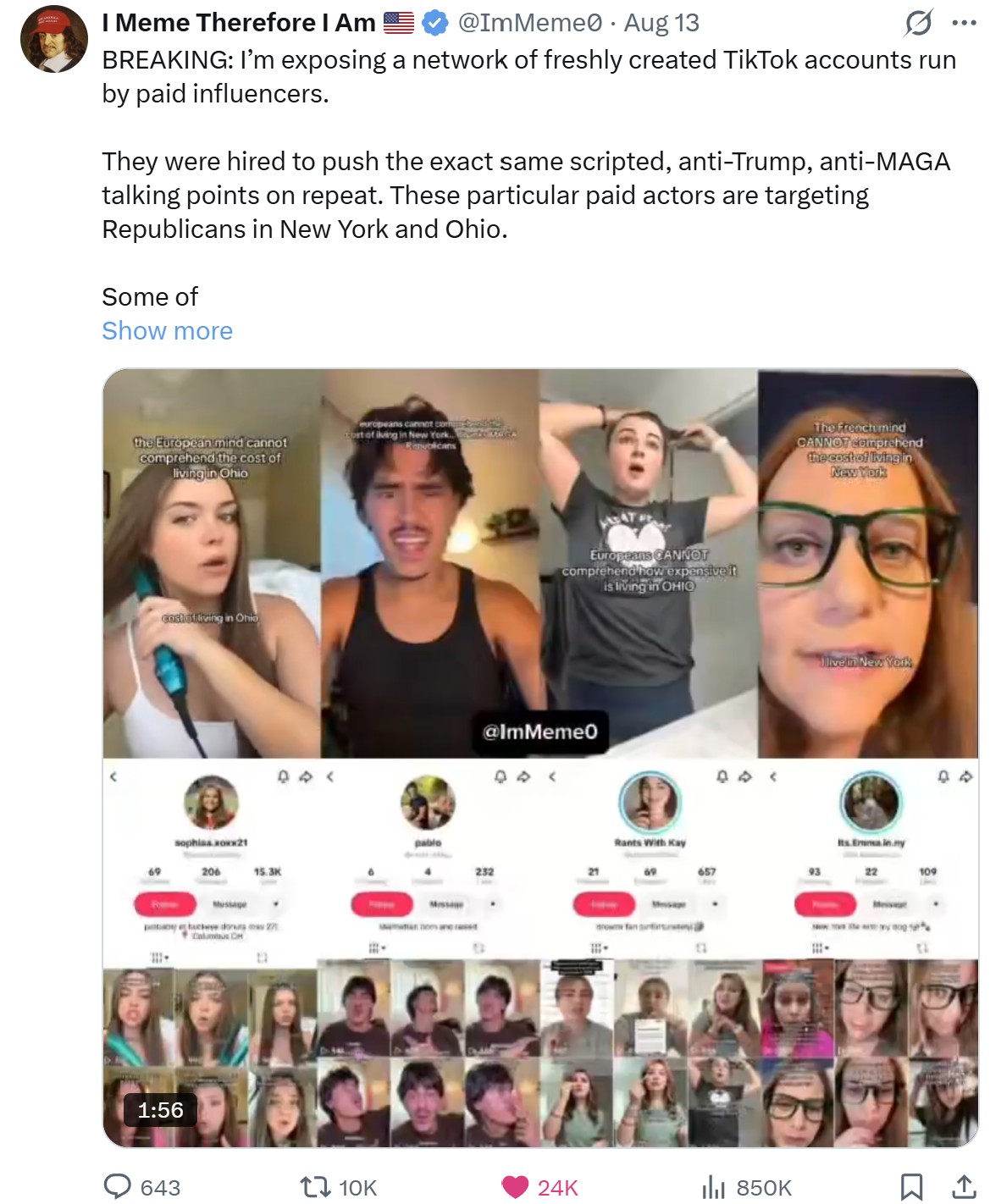
What SGI verified. Independent collection confirmed the substance: the four accounts are real members of a larger network, they were created inside a 34.5-hour window, they run a shared script, and the operator pays per post. SGI then took the network from four accounts to 113 across ten states.
On 14 June 2026 an account called kailyn.moyer posted a video about the price of dinner. She had gone to the grocery store in Pittsburgh for a basic burger dinner — beef, buns, cheese, lettuce, tomatoes, potatoes, drinks — and it came to over twenty-five dollars. She could have gone to a restaurant for twenty-two and not done the dishes. The text across the video ended on a question: “why do Pennsylvanians have to think this hard about affording dinner at all?”3
It is a good post. It reads like a person. The account had 1,765 followers.4
Four days later, an account in Wisconsin posted the same words. erin.d.930 went to the grocery store for a basic burger dinner. Over twenty-five dollars. Could have gone to a restaurant for twenty. Yes, groceries make more than one meal — that’s not the point. Eating at home used to feel affordable; now it just feels slightly less expensive. And then the same closing question, with one word changed:
| Pittsburgh, 14 June | Wisconsin, 18 June |
|---|---|
| kailyn.moyer · 1,765 followers | erin.d.930 · 1,124 followers |
| “why do Pennsylvanians have to think this hard about affording dinner at all?” | “why do Wisconsinites have to think this hard about affording dinner at all?” |
Sources: 5
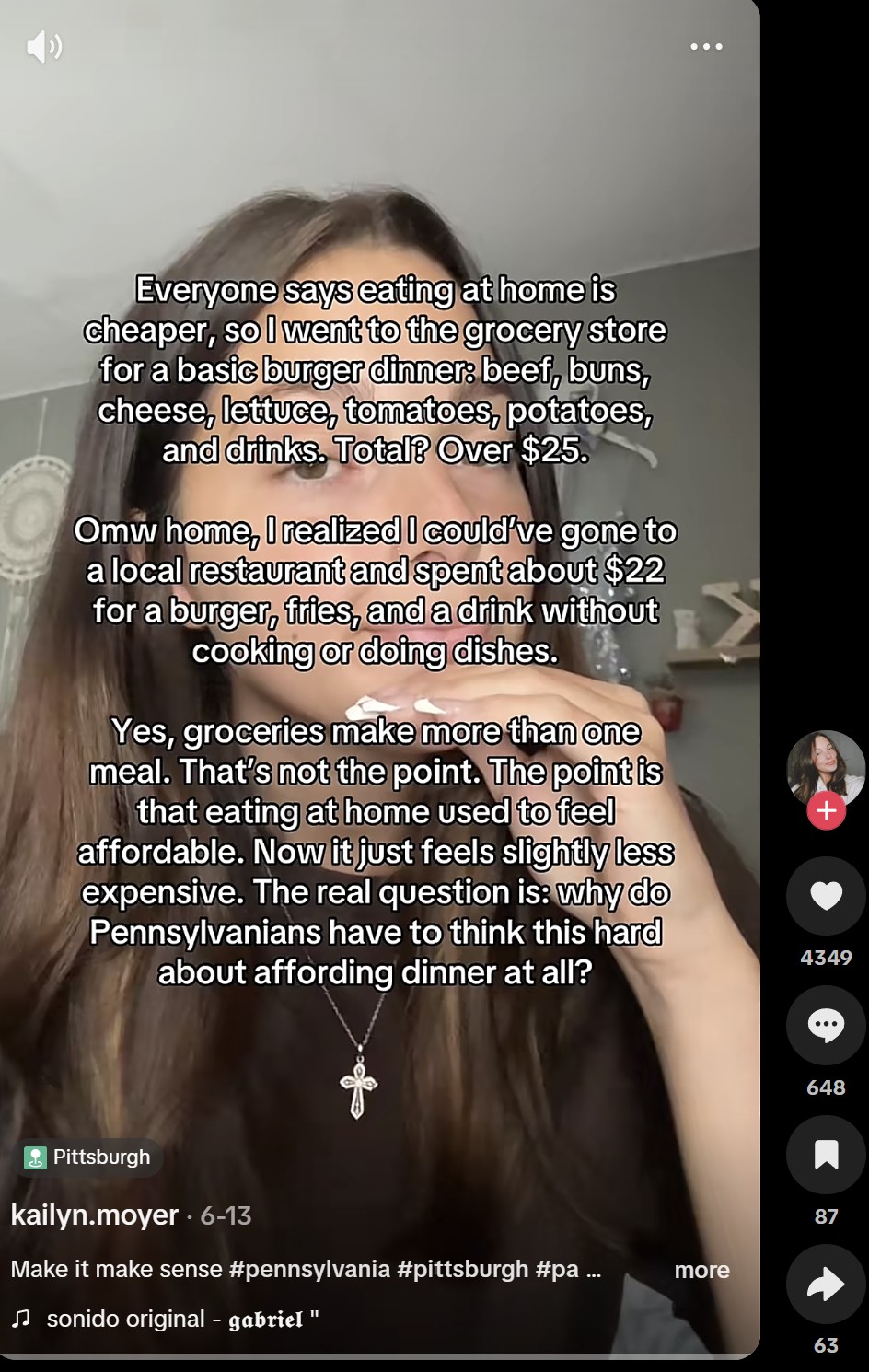
4,349 likes
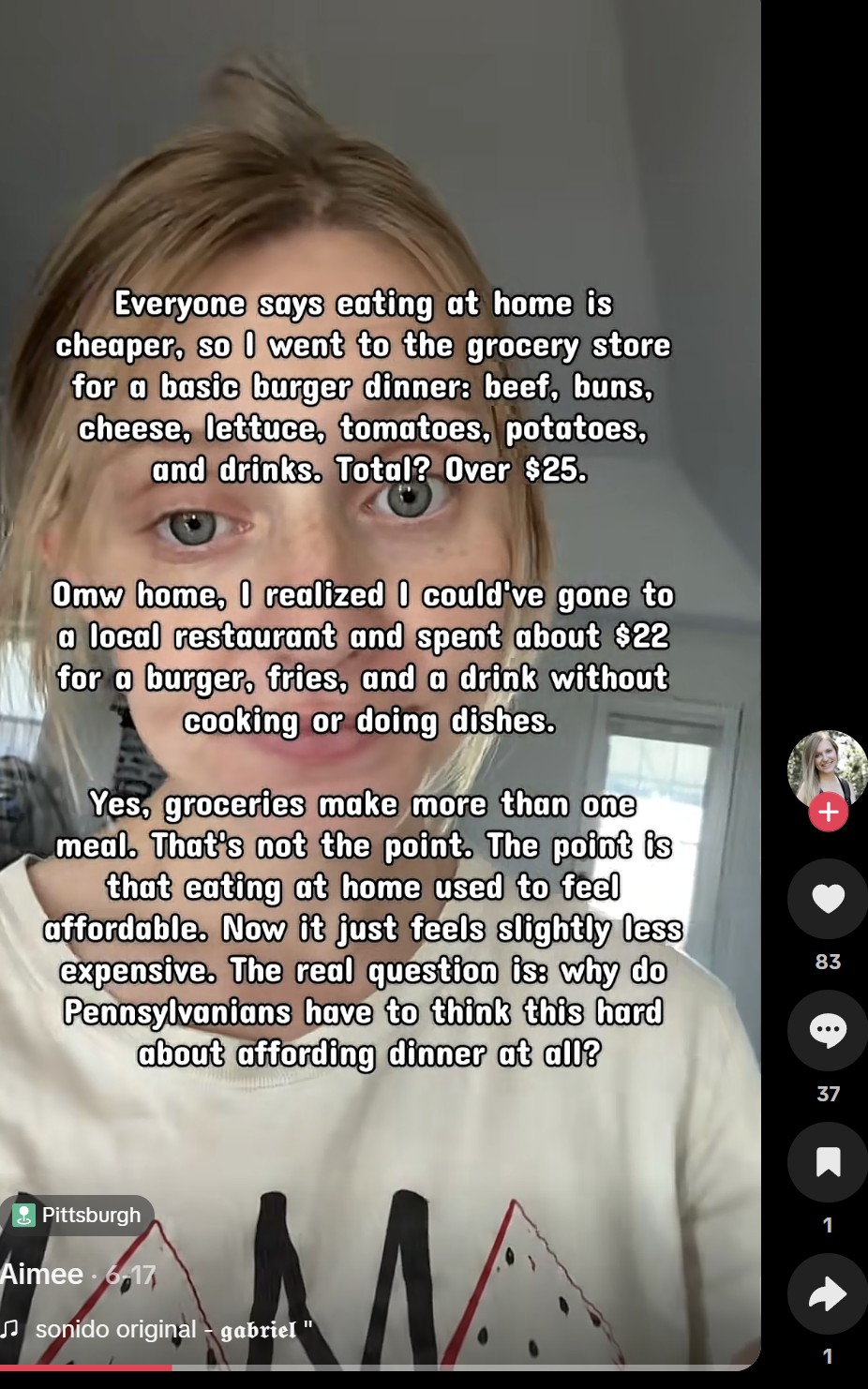
83 likes
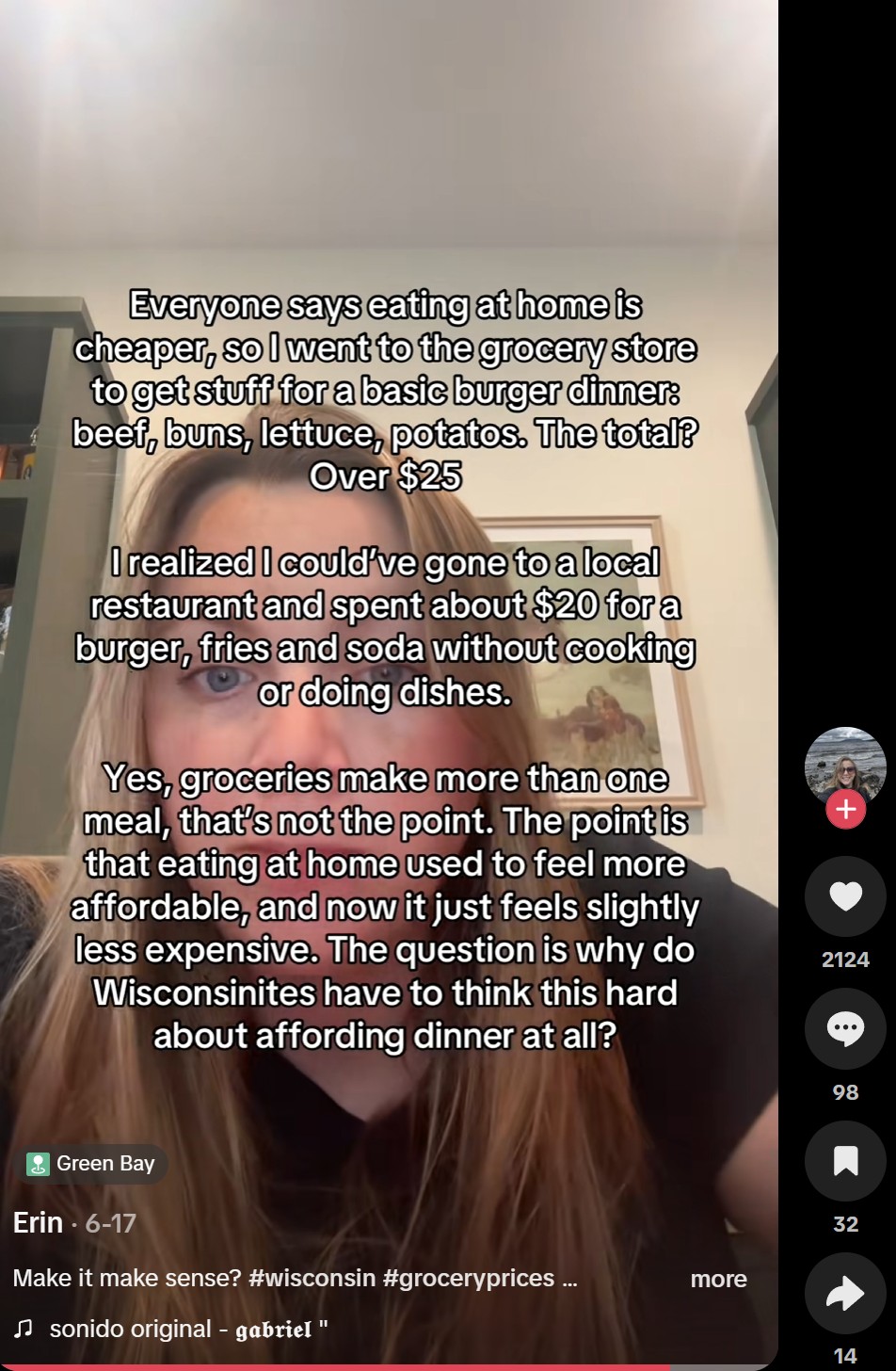
2,124 likes
Three accounts, one script, four days. The two Pittsburgh posts are word-for-word identical. The Green Bay post is the same paragraph with the ingredient list trimmed and the demonym changed. All three run the same audio track. Read them as a viewer would — one at a time, in a local feed — and each is a person having a thought about dinner.
Neither video is an advertisement, and neither says it was paid for. A third account ran the same script in the same week. Between them the three are separated by six hundred miles and no visible connection.
They are three of one hundred and thirteen.
The architecture — solid where established, dashed where assessed
CLIENT
“partner organizations”
LABS LLC
$500 / 30 posts
CREATORS
“make new accounts”
CONTENT
state-by-state
on 8,408 posts
AUDIENCES
ten states
Everything from Drumbeat rightward is documented — from corporate filings, the company’s own published material, and the posts themselves. The dashed link is the one this report cannot close: who pays Drumbeat. That is the gap, and it is deliberate to show it rather than imply it away.
This report documents a paid political influence operation running on TikTok and Instagram across ten American states. The accounts present as ordinary local people — a mother in Wisconsin, a Charlotte native, someone just yapping about Texas — and they are being paid to post. The operator is not hidden: Drumbeat Labs LLC, a company incorporated in Delaware in March 2024, which recruits creators, pays them roughly $500 for thirty posts a month, supplies the subject matter, and describes the arrangement on its own website. Its instructions to creators include a step that explains most of what follows: make new accounts.6
The measured footprint is 63.4 million views across 7,519 campaign posts from 105 accounts, drawn from a full catalog of 9,261 posts — not a sample. Of the persona accounts doing the persuading, 8,408 of 8,463 posts carry no disclosure of any kind — and neither platform's machine-readable disclosure field is set on a single post in the entire corpus.7
And the content is tuned. The same infrastructure that runs blank economic grievance in North Carolina, Pennsylvania and Wisconsin runs explicit partisan attribution in 61% of New York posts and 30% of Michigan’s, and in Michigan crosses into naming a candidate for the United States Senate. This is not a complaint about groceries. It is a distribution system with a dial on it.
| What it is | The finding |
|---|---|
| A paid political campaign | Creators are recruited and paid $500 for 30 posts a month, "based on your views," to post local-issue content. The operator, Drumbeat Labs LLC, describes the model publicly. Almost none of it is labeled as paid. |
| Wearing invented identities | Accounts are built to a formula — a first name plus a word meaning "to talk." rants.with.p, karonde.yaps, miechel.talks, ramblingwithrae. Three pairs carry word-for-word identical biographies, and a fourth shares an opening sentence. Most have double-digit follower counts. |
| At industrial scale | 113 accounts and 799 internal follow edges across Ohio, Georgia, Texas, North Carolina, Michigan, New York, Pennsylvania, Wisconsin, Iowa and Maine — mirrored onto Instagram at a verified 50% rate. Measured reach: 63.4 million views of campaign content. The operator claims 70 million across six pilots — the same order of magnitude, reached independently. |
| Saying one thing everywhere | Across 9,261 posts the message is economic despair — rent, groceries, utility bills, wages. Localized precisely: Ohio and Georgia attack data centers, nobody else does; each state's own utility is named. |
| Two products, not one | New York runs 61% partisan attribution, Michigan 30%, Ohio 21%, Texas 21%. North Carolina, Pennsylvania and Wisconsin run next to none. The same firm dials political attack up or down state by state while the economic grievance stays constant. |
| And still growing | This report described 94 accounts in nine states on 15 August. One further round of enumeration took it to 113 in ten, adding a Texas cell of fifteen and a first Iowa account. Every round so far has made it bigger. Treat 113 as a floor, not a count. |
| And asking for nothing | Almost no ask at all — no bill to back, no petition, no march. The exceptions are two, and both are documented: a named committee, and one Michigan strand advocating a Senate candidate. Zero outbound bio links across 113 accounts. The content tells people their life is unaffordable and offers no way out. Grievance without an ask is not organizing — it is mood. |
Sources: 8
The rest of the short version
What this report cannot tell you is who paid. Drumbeat says its opportunities come from “partner organizations.” None are named, no contract or payment record was obtained, and the client behind the great majority of this activity remains unidentified. Twice the mask slips and a payer appears in the open — a California gubernatorial committee on nineteen posts, mirrored across both platforms, discussed in §06. Everywhere else, the audience is told nothing at all.9
The whole network, before any of the workings
Every node below is one account, shown as its own profile photograph. Every line is a verified follow between two members — not an inference, a link that exists on the platform. Switch between TikTok and Instagram, recolour by state or by the wave the accounts were created in, and drag any node to pull the structure apart.10
What to look at. The clusters are states. The cluster in the middle is the operator layer — Drumbeat’s own account and its paid ambassadors — and it is the only part of the network that admits what it is. Notice that it sits at the centre rather than the edge, and that the state cells barely touch each other but nearly all touch it. How each of these links was established is set out in §07.
Where the evidence for each of these claims sits. The company, its founders and its published operating model are set out in §02; how the accounts were built in §03; what they say, state by state, in §04; the disclosure audit in §06; and how the network was connected, account by account, in §07. Methodology, thresholds and the full 113-account register are in the technical annex.11
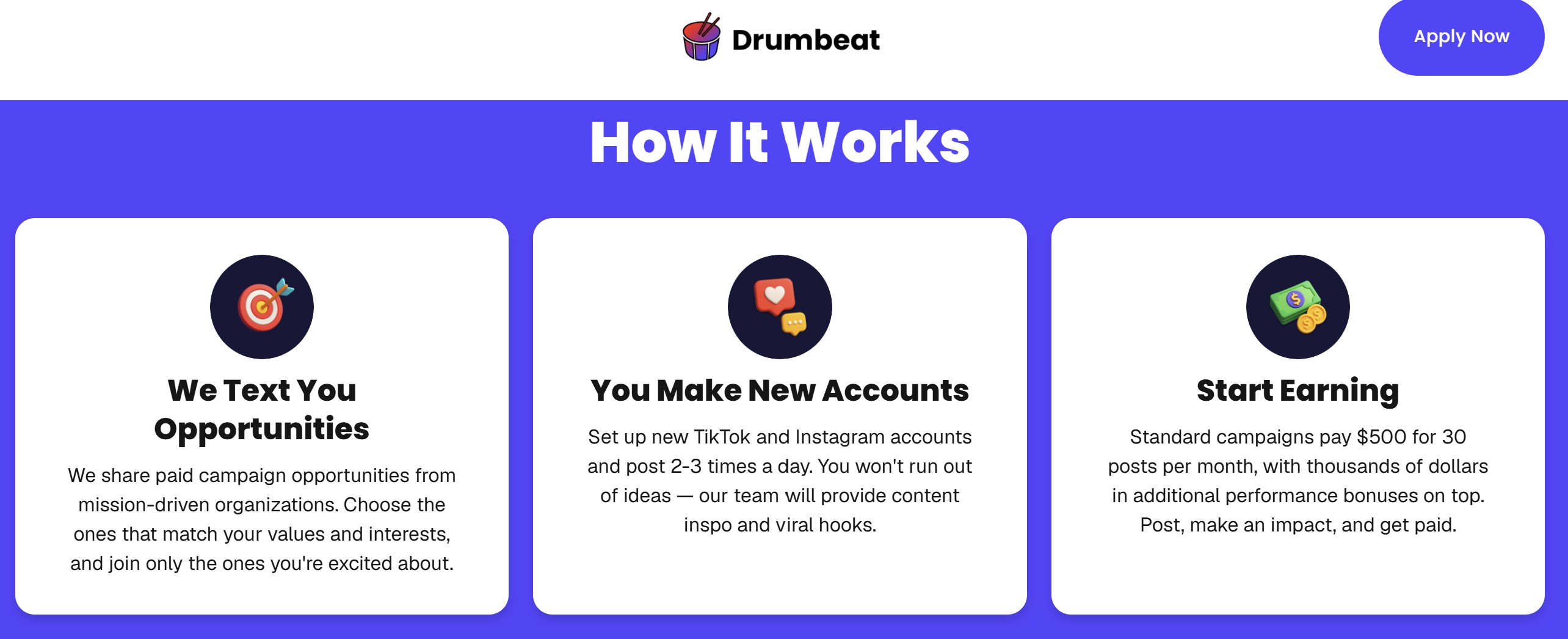
we text you opportunities · you make new accounts · start earning Drumbeat’s own “How It Works” page, describing the arrangement to prospective creators12
That middle step is the whole report. The instruction is not “post to your account” — it is make new ones. Everything that follows in this report — the invented personas, the handle formula, the provisioning waves, the duplicated biographies — is the visible result of a documented instruction, executed one hundred and thirteen times across ten states. The corporate record, both founders, and the rest of the company’s published material are set out in §02.13
Nothing in this report alleges a crime, and none of it is inferred from private sources. Drumbeat Labs operates openly and describes its business plainly. The failure documented here is one of disclosure at the point of publication — and, as §06 shows, the network is capable of labeling when a client requires it.
The accounts are invented. The grievance is real. Someone paid for the second to be delivered by the first, and did not say so. The one thing this report cannot establish is which client wrote the check.
A named company, two named founders, and a playbook they publish themselves
Everything in this section comes from public corporate filings and from the founders' own public statements. Nothing here is inferred from private sources, and nothing here alleges a crime.
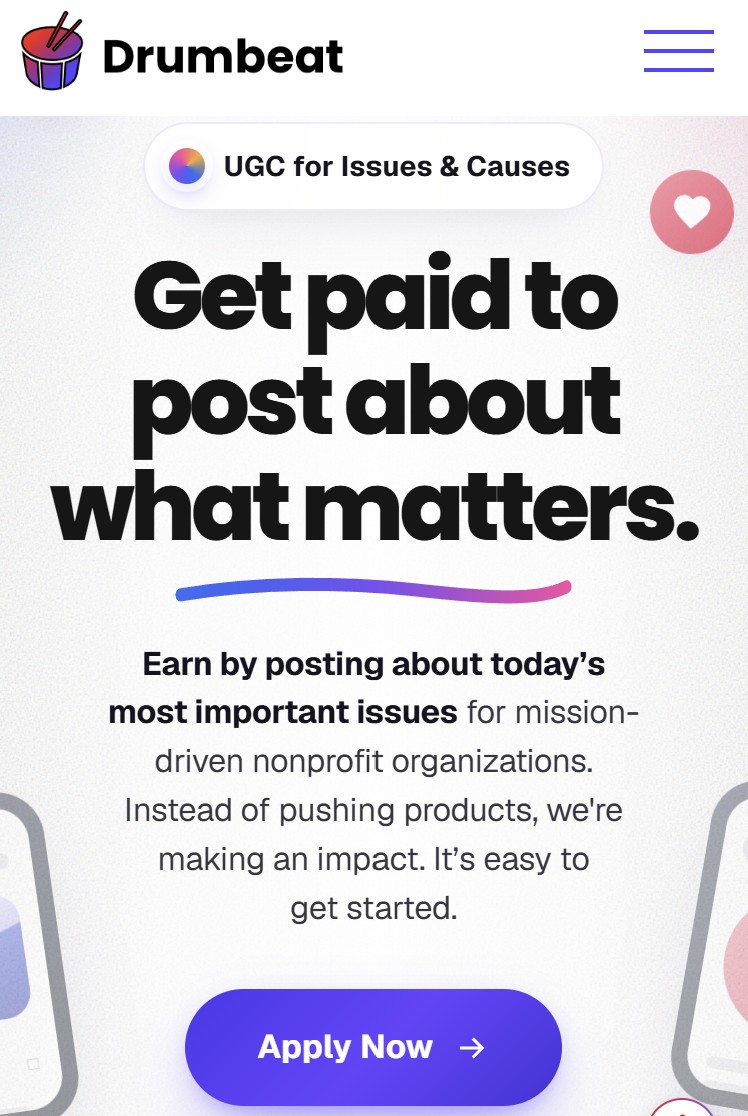
The company
| Record | Detail |
|---|---|
| Delaware parent | Drumbeat Labs LLC — 3313781, incorporated 22 March 2024, New Castle DE · agent Corporation Service Company |
| California | Foreign LLC B20250061349, registered 4 Apr 2025 · 2014 Capitol Avenue #100, Sacramento CA 95811 · agent CSC — Lawyers Incorporating Service |
| New York | Foreign LLC 7843566, registered 25 Feb 2026 · 122 East 42nd Street, 18th Floor, New York NY 10168 · agent Cogency Global |
| Virginia | LLC 11958830, incorporated 23 Jan 2026 · agent Cogency Global, Midlothian VA |
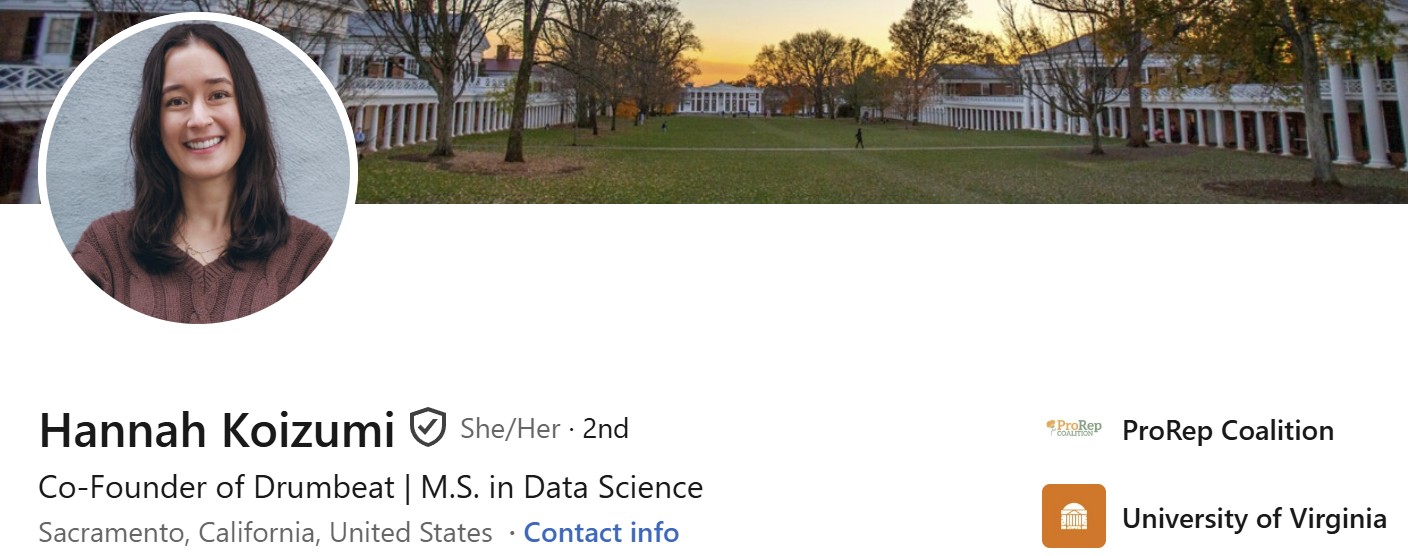
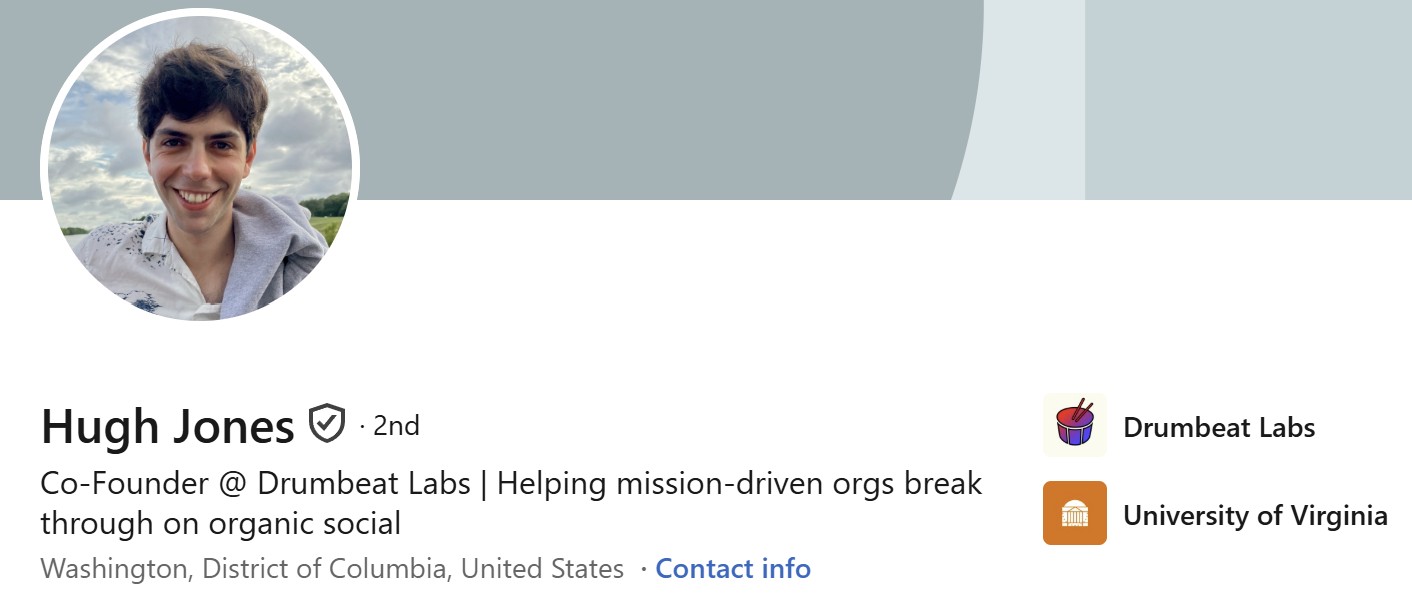
| Managers of record | Hannah Koizumi · Hugh R. Jones — named on the California filing |
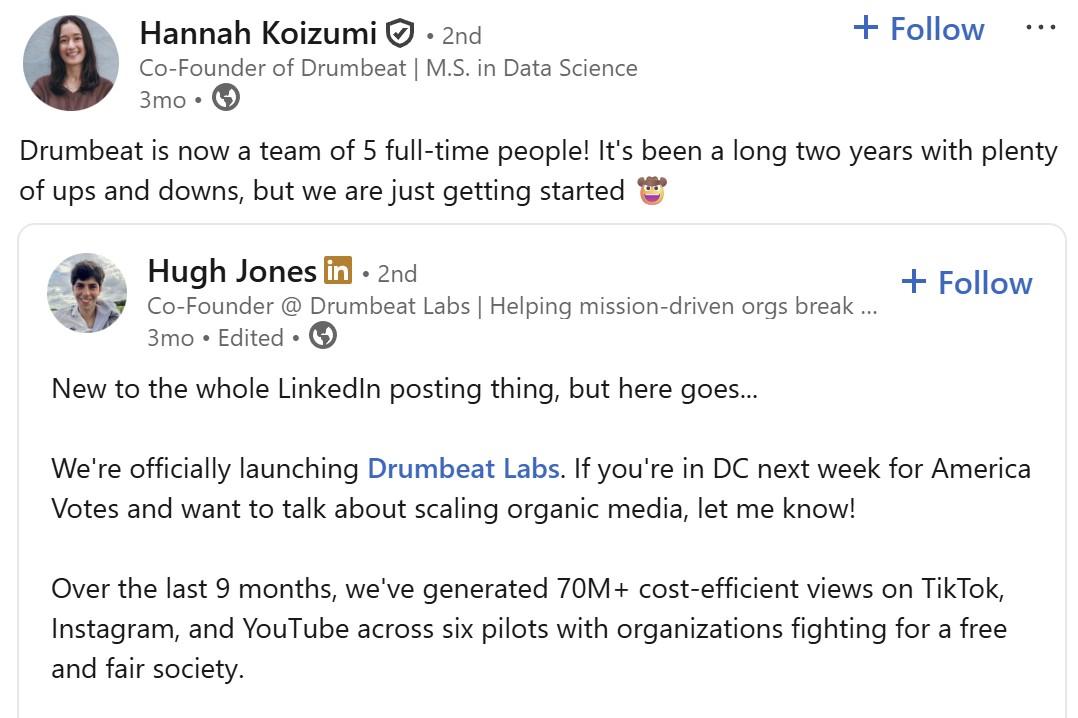
| Size | "a team of 5 full-time people" (co-founder post, ~May 2026) |
Sources: 15
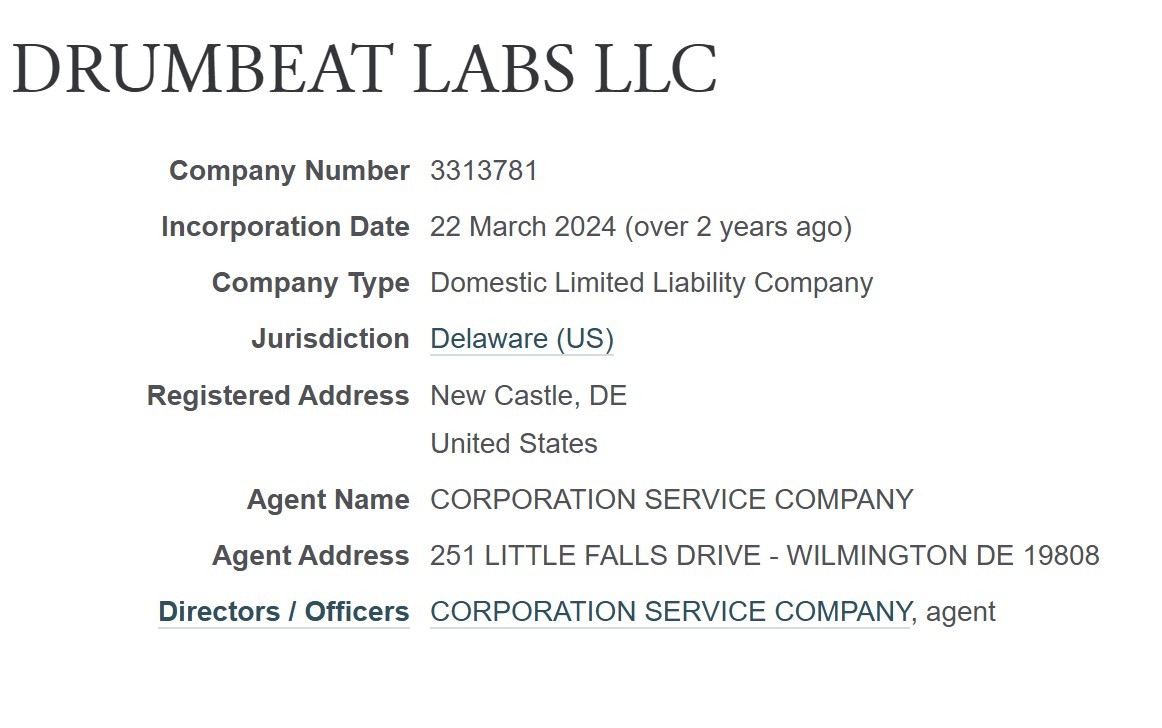
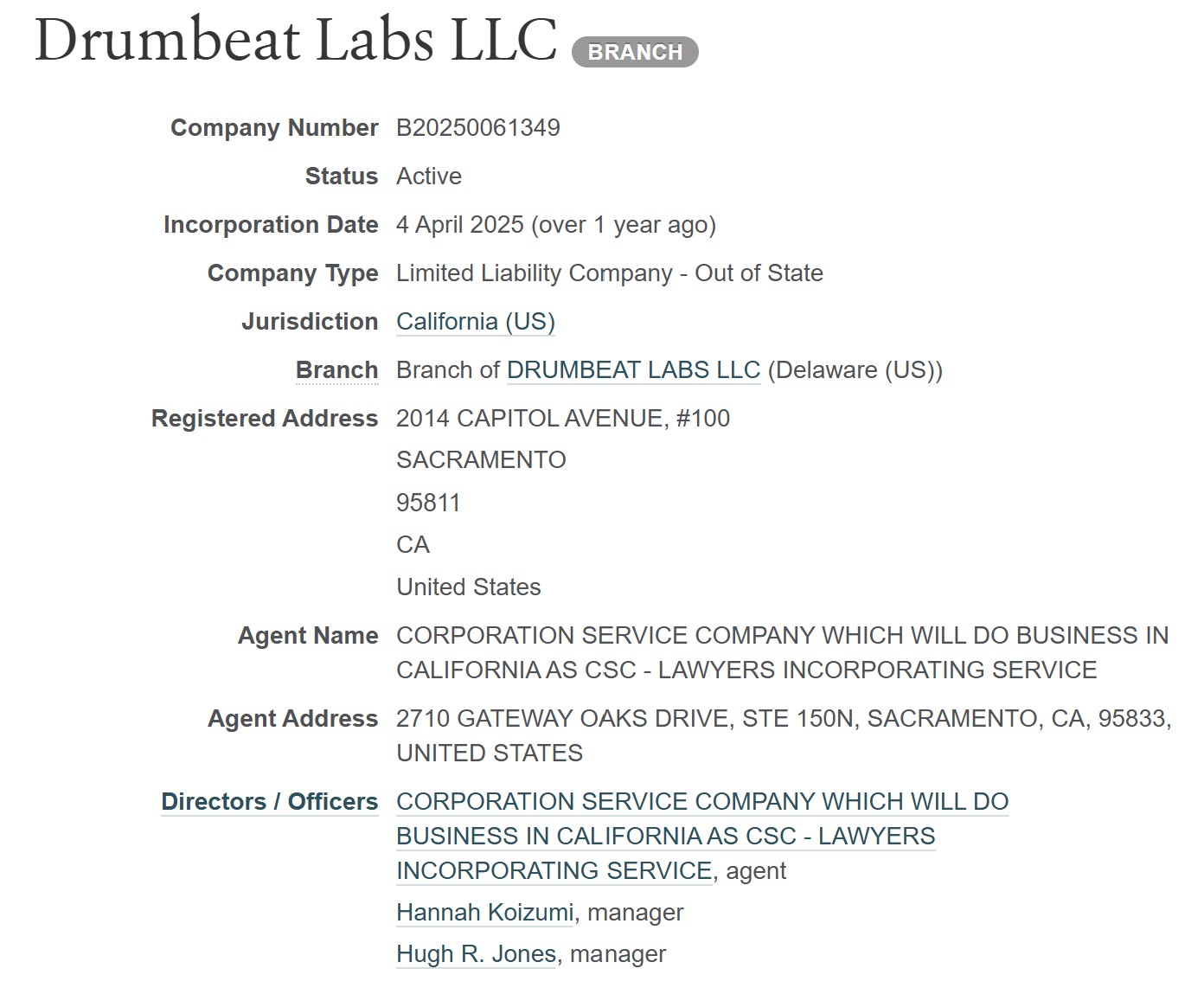
The California filing is where the principals appear: Hannah Koizumi and Hugh R. Jones, managers. The Delaware parent was incorporated 22 March 2024; the company then registered in further states, New York landing 25 February 2026 — five months before the New York persona cell appeared. Both the New York and Ohio cells sit in states where the company holds a registration. Context, not causation.
The shortest link between the company and the accounts
Everything above comes from filings. This does not. One of the two managers of record keeps a personal TikTok account, hannahkoi, and its biography states the role without ambiguity:
📍Sacramento 🥁Co-founder @Drumbeat Public biography, tiktok.com/@hannahkoi, captured 16 August 202616
That account follows five accounts in this roster — loladrumbeat, rootedbean, luckyliberal, earthluvr.444 and newsfeedfemi. Four of those five are recruiter accounts: the layer that signs creators up and is also the only layer that discloses. A named principal of the company, on a self-identified account, is directly connected to the recruitment tier of the network this report maps.
How this squares the corporate record with the accounts
What this adds, and what it does not. It closes the distance between the corporate record and the observable accounts: previously the link ran company published playbook accounts matching that playbook. It now also runs named manager follows recruiter accounts. It remains Probable rather than Proven on the question that matters most — which client paid for which state's content — because no contract or payment record was obtained. Following an account is not commissioning it. The rest of her following list, some 300 accounts, is overwhelmingly ordinary — yoga instructors, university friends — and reads as a personal account rather than an operational one, which is why it is not treated here as an enumeration source.17
The founders, in their own words
The corporate record in full
Both University of Virginia. She is in Sacramento and lists a ProRep Coalition affiliation; he is in Washington DC, describing the work as "helping mission-driven orgs break through on organic social."18
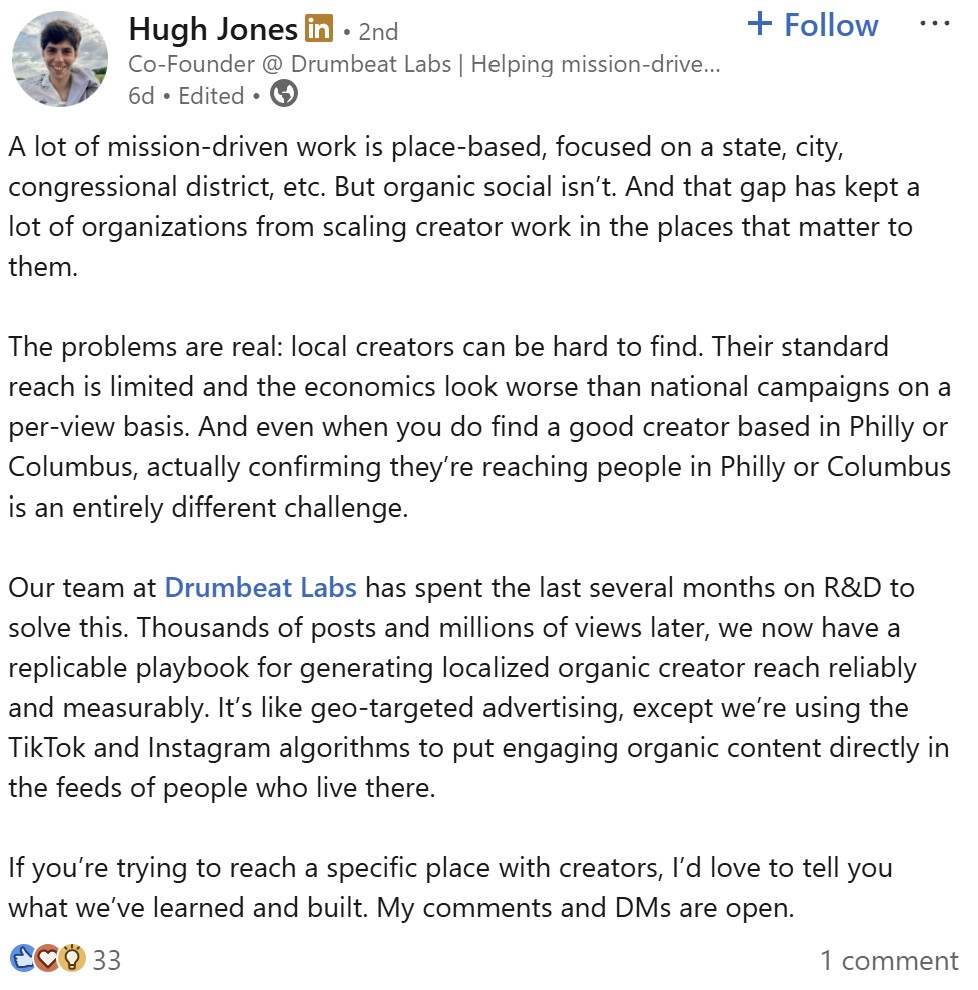
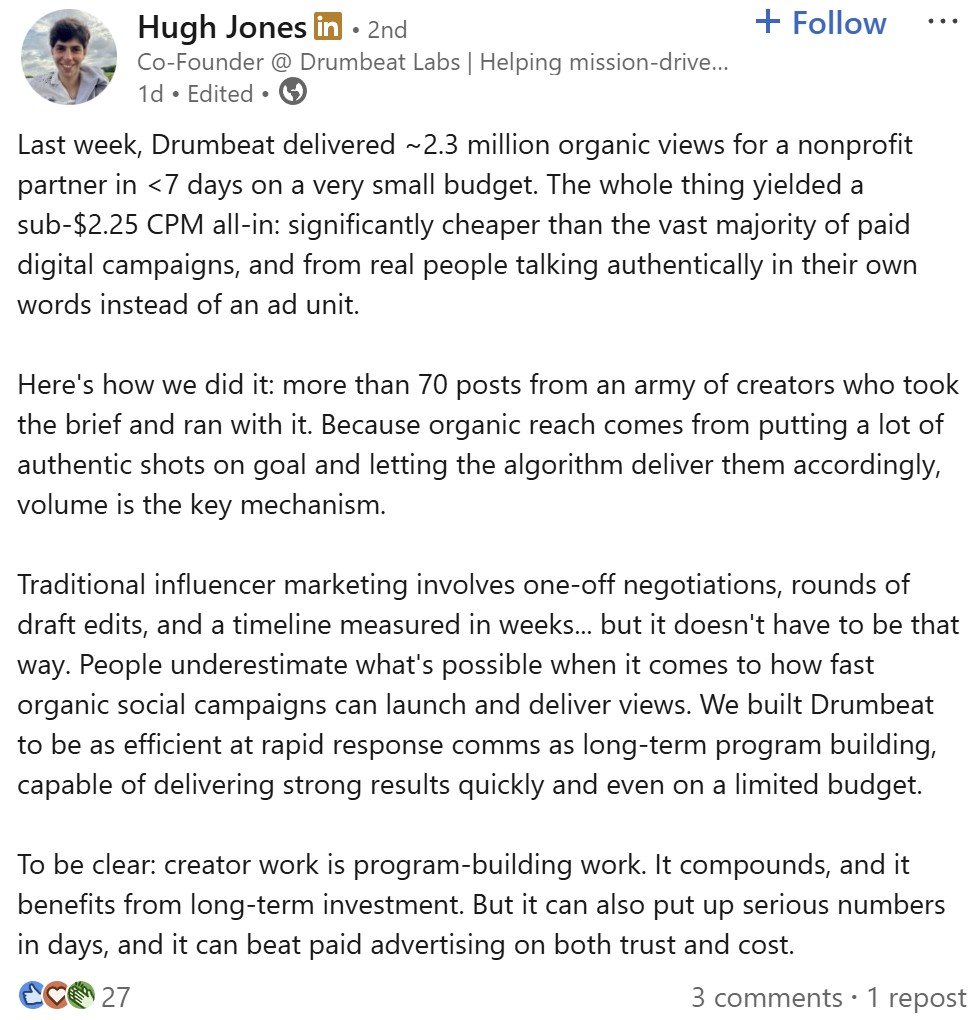
Two LinkedIn posts by Hugh Jones, published in the fortnight before collection, describe the product more plainly than any outside analyst could.20
Why those quotes matter
- The method in the report is the method they advertise. Proven · High + details New accounts on both platforms, 2–3 posts daily, supplied hooks, paid per post. Eleven structural anomalies in §07–§04 follow from that instruction sheet.
- The geography in the report is the geography they sell. Probable · Moderate + details "Place-based… state, city, congressional district," with Columbus named as the example. The Ohio cell is Columbus-anchored and the two cells are cleanly partitioned by state, exactly as a per-market campaign would be.23
- "Organic" is the product being sold. Proven · High + details The word does a great deal of work in this marketing. Paid, briefed content published on purpose-built accounts is described to clients as "organic views" and contrasted favorably with "an ad unit." The viewer is the only party in the transaction not told which it is.24
- The value proposition is borrowed trust. Proven · High + details "It can beat paid advertising on both trust and cost." The trust premium exists because the audience believes it is hearing from an unpaid neighbour. Disclosure would remove the premium — which is precisely why its absence is the story.
- Still short of proof: no contract, no client, no invoice. Probable · High + details The follow-graph link in step 4 removes the "someone else copied the playbook" alternative for most of the network, but no first-party record was obtained and the paying client is unnamed. Probable, not Proven — and the distinction is kept everywhere in this report.
Sourcing and right of reply. Corporate details are drawn from public business registries. Every quotation in this section is taken verbatim from the company's own website or from public LinkedIn posts by its named co-founders, captured 15 August 2026. Drumbeat Labs LLC was not contacted for comment before publication; the company's own public account of its methods is quoted at length here precisely so that its position is represented in its own words. ShadowGraph Intelligence will publish a correction or a response from the company on request.25
The neutral-looking accounts were built first
Account creation is not evenly spread. It arrives in three bursts — and the accounts presenting as local news feeds predate the personas that do the talking.
Wave 0 builds an audience on affordability and local-news framing. Wave 1 drops the talking-head personas into that ready-made follow graph — this is the wave the video came from. Wave 2 is still running, and was still running as this report was written: @chels.chats was created three days before collection with zero posts and already follows eight network members, and @rantswithbec — "Georgia girl with a lot to say · professional yapper, casual ranter" — has zero followers, zero posts and fourteen follows, five of them confirmed members. An empty persona, wired into the graph before it has said anything.26
The chart has a blind spot, and it is worth naming. kelsie.explains was registered in May 2021 — but every one of its eight posts landed between 11 and 15 August 2026. It is a dormant account switched on for the campaign, and creation-date analysis cannot see it. Anyone reactivating old accounts rather than making new ones is invisible to this exhibit — and kelsie.explains is no longer the only one. ganewswithparis, a Georgia account with eleven inbound follows from confirmed members, was registered in January 2024. Several of the one hundred and thirteen accounts here pre-date the waves entirely and would never have surfaced through creation-date analysis — two dormant reactivations, plus mads_ventures, an established 2019 creator with 410 videos who simply took the brief on the account they already had. One hundred and thirteen is therefore a floor, not a count.27
How the waves were identified
A fourth wave, found after the first version of this report. Enumerating the Texas and Michigan cells surfaced a provisioning cluster the original three-wave model did not contain: fourteen accounts created between 28 April and 22 May, four of them on a single pair of days. Concentrated in Texas but reaching Michigan, Iowa and California. The wave is plotted above and the dated list is in Annex E.
Why this wave was missed the first time
Why it matters that this was missed the first time. The wave model in this section was built on the accounts known at the time. It described the network as provisioned in three bursts. A single further round of enumeration added a fourth burst that is larger than two of the original three. The waves are real — the clustering is far too tight to be coincidence — but the number of waves is a function of how much of the network has been found, and should be read that way.
One formula: a first name, and a word meaning "to talk"
Forty of the 113 handles are built from the same template — a name plus an informal verb for speech. The verbs are interchangeable, and one operator proves it: nimaiyaps and nimaitalks are the same person, running two accounts whose only difference is which synonym they picked.
| Verb | N | Handles |
|---|---|---|
| rant | 7 | rants.with.p rants.with.kay rants.with.ki rants.with.rae rantswithivy rantswit.breezy sophia.ranting |
| talk | 2 | miechel.talks nimaitalks |
| yap | 4 | nimaiyaps kamyapss kamyaps karonde.yaps |
| chat | 1 | chels.chats |
| gab | 1 | graceisgabbing |
| explain | 1 | kelsie.explains |
| "news with…" | 4 | newswithchloe newswithjob newswithbri ganewswithlinds0 |
Handle shape alone proves nothing — plenty of real people use these constructions, and a search for "rants with" returns mostly fandom accounts. It carries weight here only because every account below also sits inside the same follow graph, the same creation window and the same script.28
Scroll table sideways on narrow screens
Two products, sold as one grassroots
Post captions in this network are bare hashtag strings and many videos contain no speech at all — the message lives in text burned into the frame. To read it at scale, the text was read off the video frame itself. 9,261 posts across 105 accounts. The result is the most important finding in this report.29
Partisan attribution by cell — share of that cell’s campaign posts
The same infrastructure runs at both ends of this range at once. North Carolina, Wisconsin and Pennsylvania receive economic grievance with effectively none — one percent or below. New York receives it on three posts in five. The grievance is constant; the politics is a setting. Maine and Iowa are excluded from this chart — see the note below.
| Theme | Ohio | Georgia | N. Car. | Texas | Penn. | Wisc. | Mich. | N. York | Iowa |
|---|---|---|---|---|---|---|---|---|---|
| Housing & rent | 21% | 28% | 49% | 37% | 42% | 27% | 35% | 39% | 36% |
| Utilities & energy | 29% | 22% | 35% | 17% | 16% | 22% | 5% | 25% | 15% |
| Groceries | 15% | 18% | 21% | 29% | 28% | 26% | 35% | 45% | 45% |
| Wages & jobs | 15% | 21% | 13% | 43% | 22% | 26% | 29% | 28% | 56% |
| Taxes | 12% | 9% | 5% | 23% | 12% | 13% | 2% | 5% | 10% |
| Healthcare | 7% | 11% | 2% | 1% | 11% | 9% | 6% | 4% | 1% |
| Data centers | 17% | 14% | 3% | 1% | 0% | 0% | 1% | 0% | 0% |
| Partisan attribution | 21% | 8% | 1% | 21% | 0% | 0% | 30% | 61% | 24% |
| Voting / elections | 3% | 1% | 0% | 1% | 0% | 0% | 12% | 13% | 0% |
| posts analyzed | 1,004 | 1,712 | 1,034 | 1,240 | 783 | 815 | 364 | 181 | 78 |
Michigan is the finding this table was missing. Half of Michigan's described posts — 50% — mention voting, elections, ballots or the midterms. That is the highest election rate anywhere in the network, above New York's 29%, and it sits on a cell of only three accounts. Its partisan-attribution rate, 39%, is second only to New York. Michigan is a presidential swing state, and it is being run as the most electorally explicit cell in the operation.
| Account | Caption as published | What the on-screen text actually says |
|---|---|---|
| mads_ventures | “yall we HAVE to stand up” | “flock is evil” — license-plate surveillance |
| talkingwithh | “Crazy” + gas hashtags | people move to Texas for low taxes; the cost arrives anyway |
| mads_ventures | “so this is wild” | “average us costs per month” |
| annacole5950 | “Changing too much..?” | how rents have moved |
| treysgeorgiathoughts | “Sigh…” + Georgia hashtags | a welcome-to-the-economy framing |
Sources: 30
Texas arrived as a tax campaign. The newest and second-largest cell leads the network on taxes (32%) and runs 21% partisan attribution — unlike Georgia, North Carolina, Pennsylvania and Wisconsin, which are almost purely economic. Iowa, on a single account and only 78 posts, is 56% wages. Both read as narrower, more specific products than the general-grievance cells.
How to read the small cells
Read the small cells carefully. Maine rests on 24 campaign posts and Iowa on 78, against 1,711 for Georgia and 1,240 for Texas. Percentages on that base move several points if a handful of posts are reclassified, which is why Maine and Iowa are excluded from the chart above. Michigan, at 364 posts, is small but not marginal: the direction of its finding is robust, the precise figure less so.
Why these rates changed, and what the old ones measured
Why these rates changed from an earlier version. An earlier table scored each cell only on posts carrying a machine-readable scene description. That instrument is unusable for comparison: its coverage runs from zero percent before 2026 to 86% by August, so it ranked cells by how thoroughly they happened to be collected. Every rate here is now computed on caption plus on-screen text read from the video frame, which covers 99.5% of the catalog and treats a September 2025 post exactly like an August 2026 one. New York fell from 75% to 61%, Michigan from 39% to 30%, Texas from 25% to 21% and Ohio from 24% to 21% — the magnitudes moved, the ordering did not.31
The partisan row is the story, and it is not a clean split. Five cells carry real political attribution — New York 61%, Michigan 30%, Iowa 24%, Ohio 21%, Texas 21%. Four carry next to none — Georgia 8%, and North Carolina, Pennsylvania and Wisconsin at one percent or below. The same operator is running an attack product in some states and pure economic anxiety in others, in the same costume, at the same time. An earlier version of this report described that as two products. With ten cells measured it looks more like a dial: the partisan content is turned up or down state by state, and the states where it is turned up are not the states where the network is largest.
The localization is real, and it is granular. Data centers appear in 17% of Ohio posts and 14% of Georgia's — against two posts out of 781 in Pennsylvania, and none at all in Wisconsin or New York. Each state's own utility gets named: FirstEnergy and AEP in Ohio, Duke Energy in North Carolina, Alliant in Wisconsin. This is precisely the capability the operator advertises — "a state, city, congressional district" — executed at the level of which power company sends your bill.32
The strand that is not about groceries
One topic in this network is not a cost-of-living theme at all, and it behaves differently from everything else: Flock, the automated license-plate-reader camera system that towns buy for their police departments. 39 posts across 20 accounts — Ohio, Georgia, North Carolina and the ambassador cell — between 17 June and 15 August 2026, carrying 4.5 million views. Ohio runs it hardest, at 19 posts.33
It matters for three reasons. First, the framing: almost every one of these posts routes surveillance back through the household budget — "but we have millions for flock camera's", "Georgia homeowners are now being asked to pitch in to pay for", "how am i supposed to afford my college tuition AND rent". The grievance is not privacy. It is money spent on this instead of on you.34
Second, the repetition. newswithchloe posted the identical caption — "we need to fix our priorities #ohiotok #ohiopolicy #flock" — five times between 11 and 14 August. Organic opinion does not duplicate itself word for word five times in four days; scheduled content does.35
Third, the link to the paid program is explicit. kamyapss, one of the eight recruiter accounts, posts Flock content that carries the recruitment pitch in the same caption — "what do you think about this? and if you want to be paid to…". A topic being pushed by an account whose function is to sign up paid creators is not a topic that arrived organically.36
Why this is flagged rather than resolved. Flock is a live local-government controversy in all three states, and ordinary people post about it constantly. The finding here is not that concern about license-plate readers is manufactured — it plainly is not. It is narrower and more specific: a coordinated paid network picked this topic up across four cells inside eight weeks, framed it as a budget grievance rather than a civil-liberties one, and ran it through the same undisclosed personas as the rent and grocery content. Whether that reflects a client brief or creators following a trend is not established from outside.
The caption is deliberately empty
There is a habit running through this network that is easy to miss and hard to explain innocently. The caption very often says nothing at all, and the entire argument is burned into the video as on-screen text.37
The clearest case is also the network’s biggest post. A video on mads_ventures that reached 4.2 million views carries the caption “yall we HAVE to stand up” — seven words that name no subject. Read the frame instead and the text across the top of the video says “flock is evil”. The post is about automated license-plate surveillance. Nothing in the caption tells you that.38
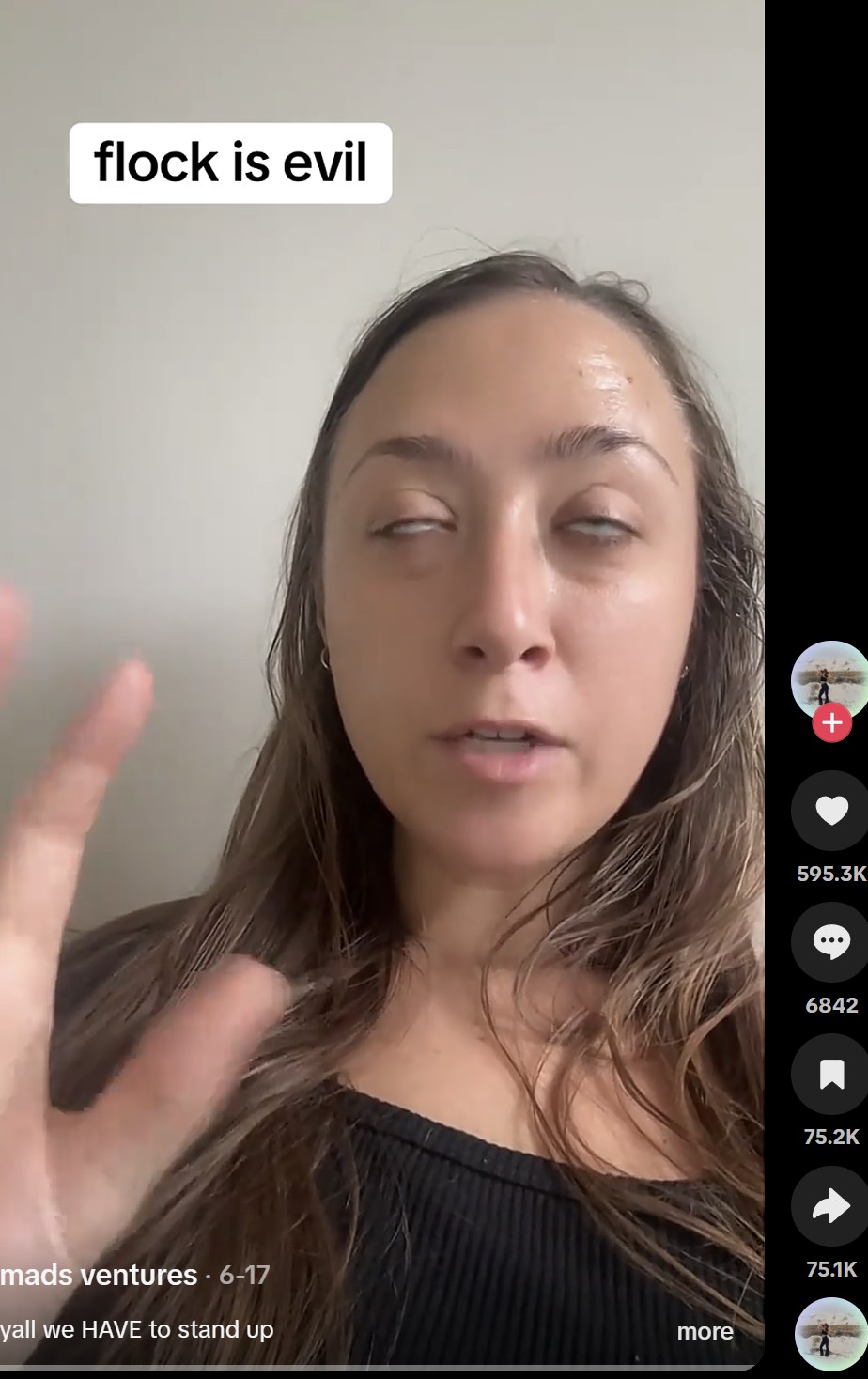
It is not a one-off. In May 2026 talkingwithh published a run of videos captioned only “Crazy” followed by a block of place-and-industry hashtags — #texas #dallas #gas #gasstation #oil — repeated across separate posts on the 13th, 14th, 15th, 18th, 19th, 25th and 28th. The caption is inert every time. The on-screen text is where the claim lives: that people move to Texas for the low taxes and find the costs waiting for them somewhere else.
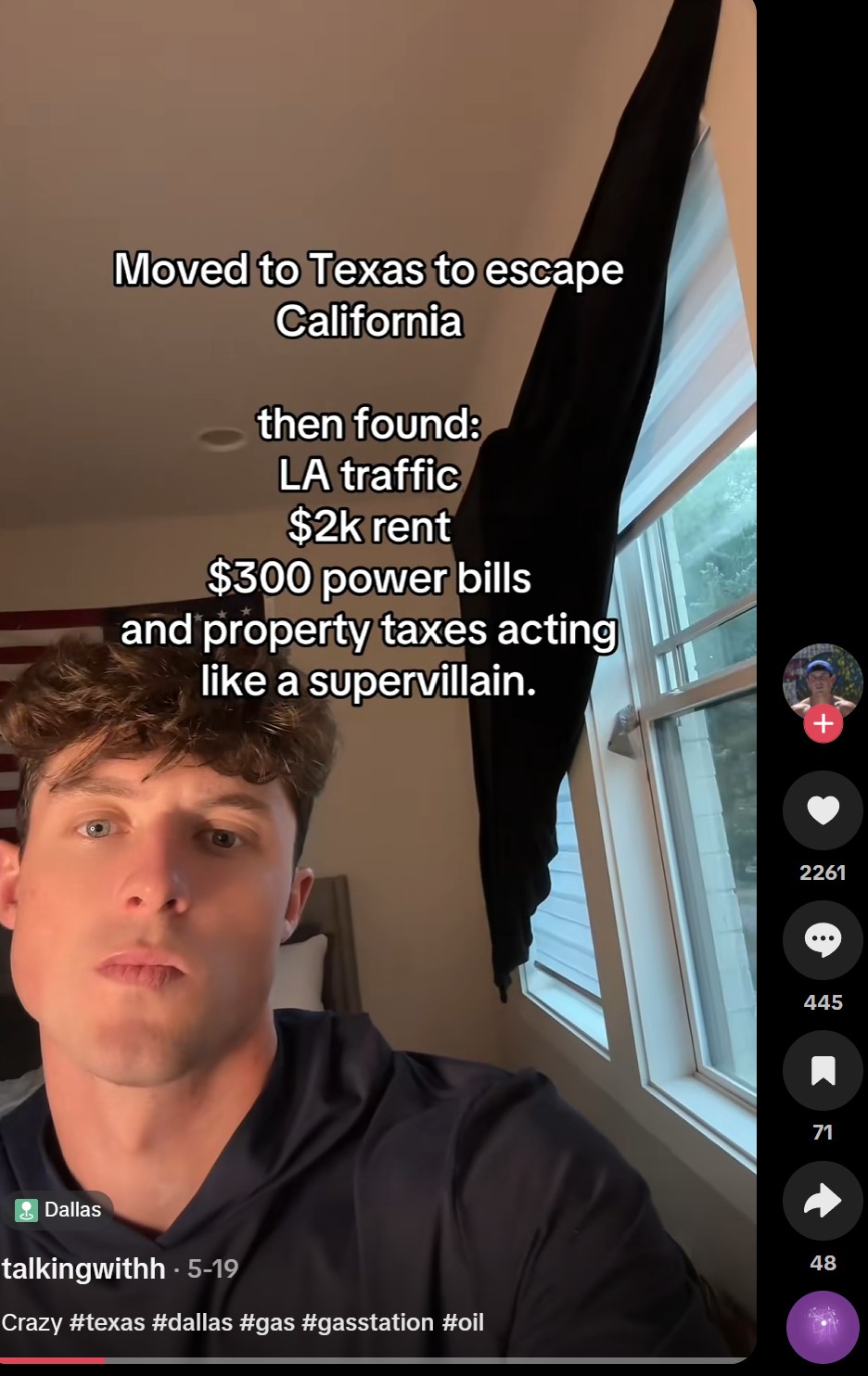
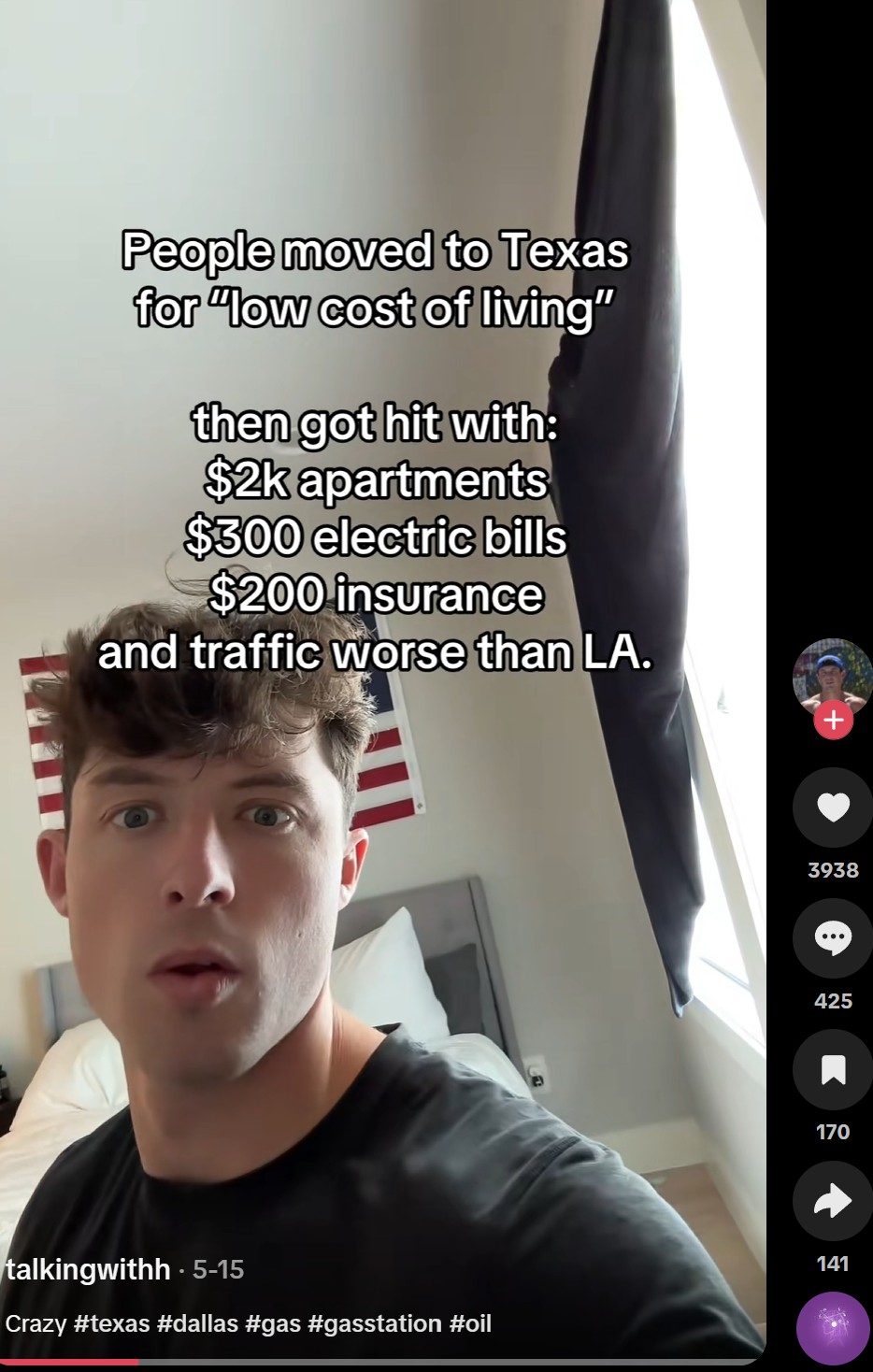
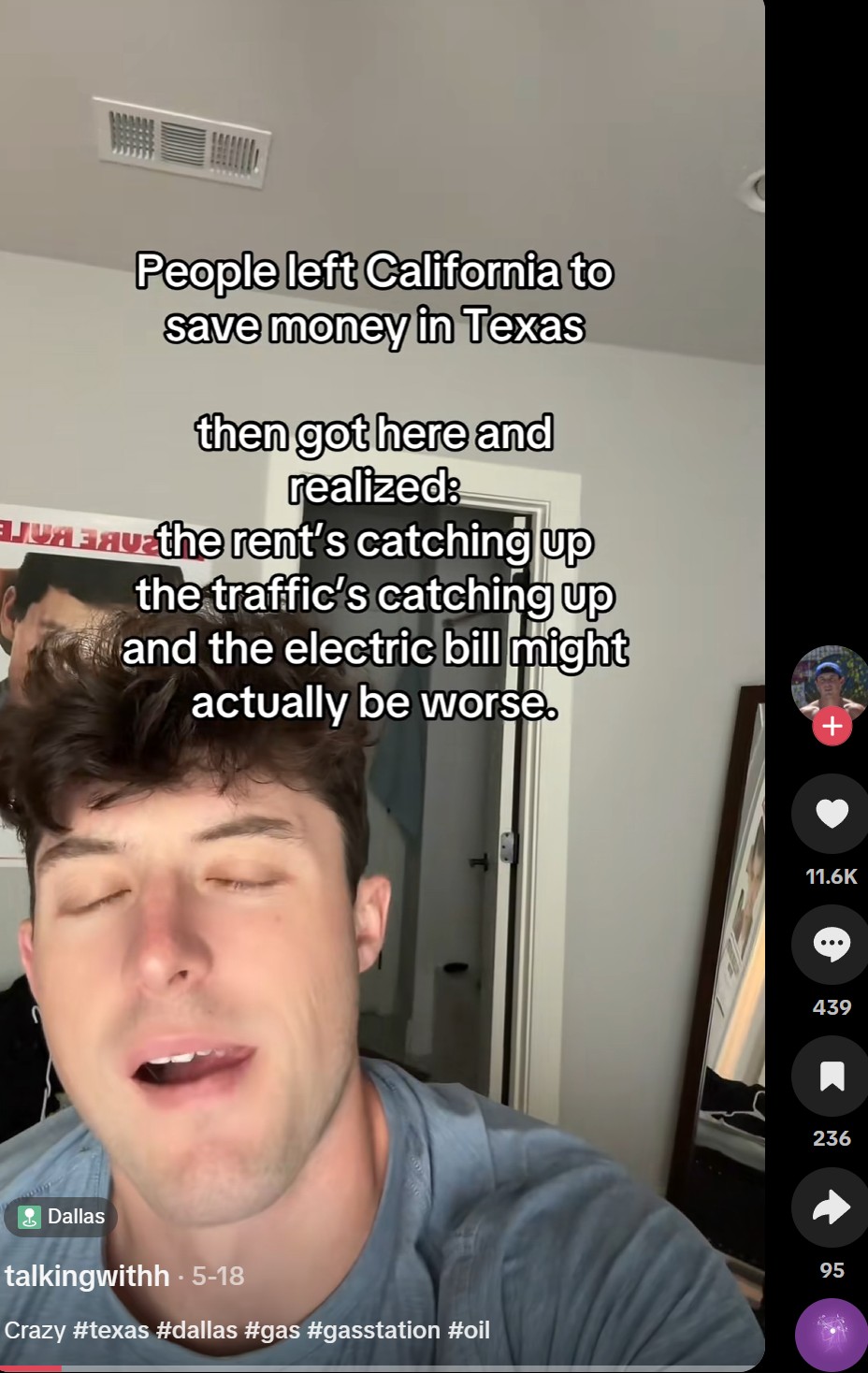
One caption, three arguments. Every one of these posts is captioned “Crazy #texas #dallas #gas #gasstation #oil” — identical, and empty. The hashtags do the geographic targeting; the claim is burned into the frame where no caption-based system reads it.
The effect is that the message and the label point in different directions. The hashtags do the targeting — a city, a state, an industry — while the caption stays content-free, and the substance is placed where only a viewer sees it. Automated systems that read captions do not see the claim. Neither does a researcher who audits captions, which is the ordinary way large samples of social media get read.
Measured across the whole catalog, the caption hides a sixth of this operation. Classifying every post on its caption alone finds 6,499 campaign posts and 52.3 million views. Classifying the same posts on caption and on-screen text finds 7,519 posts and 63.4 million views. The difference — 1,020 posts carrying 11.1 million views, 17.5 percent of the campaign — is content that is unmistakably on-brief once you read the frame and invisible if you read only what was typed into the caption box.40
That gap is not evenly spread. It is concentrated on the highest-performing posts, because the videos built to travel are the ones given a bare caption and a block of location hashtags. The single largest post in the network sits inside it.
This report initially made exactly that mistake, and says so. An earlier pass classified posts by caption and hashtags. On that reading, the 4.2-million-view surveillance video was not affordability content and the talkingwithh gas series was not cost-of-living content, because their captions do not contain the words. Reading the frame reversed both. Every reach and theme figure in this report is now built on the on-screen text as well as the caption — the method is set out in Annex A — and the direction of the earlier error is worth stating plainly: caption-only reading always undercounts this network, never overcounts it.
What is missing from all 9,261 posts
There is almost no ask. Across 9,261 posts there is, with the two exceptions set out in §06, no candidate to vote for, no bill to support, no petition to sign, no organization to join, no march to attend. Not one of the 113 accounts carries an outbound link in its bio. No donate page, no campaign site, no shop. Four publish a contact email address and nothing else — one of which is how two of the personas were tied to the same operator.41
That absence is doing work. Content that assigns blame without requesting an action is not organizing and does not have to behave like it: it never has to name a client, file a disclosure, or account for a dollar. It leaves an impression rather than a demand — that life is unaffordable, that it is someone's fault, and that nothing can be done. Whatever else this is, it is not a campaign asking people to act. It is a campaign asking them to feel a certain way, at scale, without telling them who is paying.
How theme rates are calculated
Method. Theme rates are the share of a cell's campaign posts whose caption or on-screen text matches a keyword set for that theme; posts can match more than one. On-screen text is read by optical character recognition of the video's cover frame, available for 99.5% of the catalog — see Annex A. "Partisan attribution" counts any mention of a party, a named official, MAGA, or voting and elections. Maine (24 posts) and Iowa (78) are excluded from the chart as too thin to compare against cells of a thousand.42
63.4 million views of content nobody labeled
This is the whole catalog, not a sample. Every post that could be retrieved from all 113 accounts on both platforms was collected and read — 9,261 posts — then filtered down to the ones that actually carry the campaign. What follows counts only that filtered set.43
Ten states and the operator layer — accounts and measured reach
Account count and reach do not track each other. Ohio has twenty-five accounts and 3.3 million views; Texas has fourteen and 18.3 million. Georgia carries more reach than the next three cells combined, most of it through a small number of pre-existing creators rather than the personas around them.
Two kinds of account, two different jobs
Sixteen accounts out of one hundred and thirteen carry 61% of the reach, from 21% of the posts. Across both platforms a pre-existing creator earns 5.9 times the views per post of a purpose-built persona — 24,332 against 4,126 — because it arrives with an audience that followed it for other reasons. The manufactured accounts supply saturation; the real creators supply borrowed trust. That combination is the actual design, and it is why calling this “a bot network” would understate it.44
Where the reach actually comes from
Splitting the same campaign content by what kind of account carried it produces the most operationally interesting number in this report.
| Account type | Accounts | Posts | Views | Engagements | Views / post |
|---|---|---|---|---|---|
| Purpose-built personas created 2026, for this | 89 | 3,871 | 20,106,729 | 1,969,776 | 5,194 |
| Pre-existing accounts real creators who took the brief | 16 | 1,215 | 27,805,200 | 3,811,434 | 22,884 |
| All TikTok campaign content | 105 | 5,086 | 47,911,929 | 5,781,210 | 9,420 |
Sources: 45
Sixteen accounts out of one hundred and thirteen delivered fifty-eight percent of the views, from twenty-four percent of the posts. On TikTok alone the same gap is 4.4 times — 22,884 views per post against 5,194 — because it arrives with an audience that followed it for other reasons. The invented personas supply volume; the real creators supply reach. And it is the second group where the disclosure failure does the most damage, because those audiences have a relationship with the account that the content then trades on.
| Account | Cell | Campaign views | Share of total |
|---|---|---|---|
| henkeisjj | Georgia | 14,289,007 | 23% |
| talkingwithh | Texas | 9,996,653 | 16% |
| mads_ventures | Georgia | 6,014,387 | 9% |
| texasgrlspam | Texas | 5,239,059 | 8% |
| jennopalis | Michigan | 3,935,096 | 6% |
| Cell | Accounts | TikTok posts | TikTok views | Views / post | Instagram views |
|---|---|---|---|---|---|
| Georgia | 26 | 1,125 | 14,839,949 | 13,191 | 9,048,210 |
| Texas | 14 | 931 | 13,830,393 | 14,855 | 4,453,245 |
| North Carolina | 7 | 612 | 3,374,493 | 5,513 | 713,913 |
| Michigan | 5 | 326 | 4,031,626 | 12,366 | 56,360 |
| Operator & ambassadors | 11 | 223 | 3,325,051 | 14,910 | 81,560 |
| Ohio | 25 | 677 | 3,045,200 | 4,498 | 279,183 |
| Wisconsin | 5 | 508 | 2,836,606 | 5,583 | 339,229 |
| Pennsylvania | 4 | 465 | 2,178,938 | 4,685 | 447,207 |
| Iowa | 1 | 78 | 320,909 | 4,114 | 0 |
| New York | 6 | 127 | 92,661 | 729 | 34,068 |
| Maine | 1 | 14 | 36,103 | 2,578 | 1,504 |
How the reach figures break down
One post carries a ninth of the total. A single video on a pre-existing Georgia account reached 4.2 million views — 8.8% of all TikTok campaign reach on its own. Strip it out and the TikTok figure is 43.7 million across the remaining 5,085 posts. Both numbers are given because a reader is entitled to know how much of a headline rests on one video. Notably, that post is not about groceries or rent: it is about Flock surveillance cameras, a strand the network ran across Ohio, Georgia and North Carolina — see §04.46
How much of this rests on very few accounts
The 63.4 million is not spread evenly, and a reader should see how unevenly before relying on it. Two accounts carry two fifths of it.47
And the largest of them is topically mixed, which is a problem this report has to own. henkeisjj supplies 57% of the entire Instagram figure from 219 posts. Its biggest post — 3.2 million views — is squarely on-brief: "Smiling so i don't collapse, trying to survive this HORRIBLE economy." But the same account also posts about Palestine, Black Lives Matter, reproductive rights and climate, and it staples the same hashtag block — #economysucks #costoflivingcrisis #genz #fyp — onto all of it. The classifier reads those tags and counts the post.
So a share of that 9.3 million is not cost-of-living content. How large a share is a judgment call this report does not pretend to make precisely: "If wealth created value on its own, things would be way better by now" is economic; "All lives matter until it's minorities" is not, and both carry the identical tags. Strip the account out entirely and the campaign total is 49.1 million rather than 63.4 million. The true figure sits between those two, closer to the upper end, and both are given so a reader can choose their own footing.48
The account itself is not in doubt. henkeisjj clears the follow threshold on three roster links, carries a verified Instagram mirror with an identical bio, and posts affordability content throughout. What is in doubt is only how much of its reach belongs in an affordability total — a question of classification, not membership. The same caution applies in reverse to the network's largest single post, the 4.2-million-view Flock video on mads_ventures, discussed above.49
By state
Reach and partisanship mostly run in opposite directions — with one loud exception. New York is the most politically explicit cell at 61% partisan attribution, and the weakest by reach at 700 views per post. Georgia and North Carolina run almost pure economic grievance and deliver the volume. But Michigan is both: 30% partisan, and 12,366 views per post — well above the network median, on five accounts. Where the attack product travels, it travels on a pre-existing creator’s audience rather than on invented personas.
Cell size and cell reach are different things. Michigan is five accounts and 4.1 million views because one of them is a pre-existing creator; Ohio is twenty-five accounts and 3.3 million. Counting personas measures how much infrastructure was deployed in a state. It does not measure how many people there heard the message.
The Instagram half, audited post by post
The Instagram mirrors were pulled in full rather than sampled: 3,213 posts across 70 accounts, carrying 17,073,250 views, of which 15,454,479 are on campaign content — a third of the TikTok figure from two-thirds of the posts. An earlier version of this report put the Instagram total at 3.7 million, because only 44 of the 88 confirmed mirrors had ever had their posts pulled. They now all have.50
Pulling every post also allowed a check a sample cannot support. Instagram attaches a machine-readable paid partnership flag to any post a creator declares as commercial. Across all 3,213 posts, that flag is set on exactly zero of them. This is not an inference from what the captions say — it is Meta's own field, read on every post in the mirror network, returning nothing.51
This is not social media. It is a delivery system wearing its clothes.
The central point of this report is easy to lose in the account counts, so state it plainly.
Disclosure across the whole corpus
Both platforms expose a disclosure field, and neither is ever used. Meta's paid-partnership flag is set on none of the 3,213 Instagram posts; TikTok's branded-content flag is set on none of the 6,048. These are not inferences from what the captions say — they are the platforms' own machine-readable fields, read on every post in the corpus, returning nothing in both directions.52
Ordinary influencer marketing pays an existing person with an existing audience and an existing relationship with that audience. The follower chose to follow them. Whatever else is wrong with it, there is a real human relationship being monetized, and the audience can see the account's history.
That is not what happened here. The accounts were built for the campaign. Twenty-four personas created in three waves across seven weeks, each spun up on two platforms simultaneously, each with no history, no prior audience and no relationship to monetise. The persona is not a person who was hired — it is infrastructure that was manufactured, and the human in front of the camera is the last component fitted.53
The people delivering the lines may sincerely believe every word. That is not the issue, and this report makes no claim about their convictions. The issue is that they were paid to say it, handed "content inspo and viral hooks" to say it with, and placed on accounts constructed so the audience would read them as a neighbour rather than a channel. Belief is irrelevant to the deception; the concealment of the arrangement is the deception.54
What the viewer sees is a stranger in Columbus who can't afford groceries. What is actually happening is a purchased distribution channel, built to order, delivering a brief. Nine beats, four accounts, one script — and 8,408 persona posts across the network without a single word telling anyone it was paid for.
The effect at scale is not persuasion so much as saturation. The founder's own description — "volume is the key mechanism," "a lot of authentic shots on goal," 70+ posts in a week, 2–3 per creator per day — is a strategy of flooding a local feed with scripted, prepackaged goods until the synthetic version of a conversation crowds out the real one. Someone in Columbus scrolling their local tag does not encounter one paid message; they encounter a manufactured consensus.
And the counterfeit is deliberately hard to tell from the real thing, because the counterfeit is sold on being hard to tell from the real thing. That is what "beat paid advertising on both trust and cost" means. The trust premium is harvested from the audience's belief that nobody is being paid.
9,261 posts. Almost every disclosure came from a recruiter.55
The full corpus — 9,261 posts across 105 accounts — was searched for any disclosure signal at all: a Drumbeat mention, #ad, #sponsored, #paidcreator, or a paid-partnership tag. The distribution is perfect, and that is what makes it damning.
Almost no persona discloses: 55 posts out of 8,463, and 42 of those sit on one account. Every other disclosure in this network — 126 posts in all — comes from the handful of accounts whose job is recruiting more creators. On those, the tag is near-universal: nimaiyaps carries it on sixteen posts out of sixteen. The accounts doing the persuading carry it on none.56
The disclosure evidence in full
A blanket absence could be explained by ignorance — nobody told the creators the rule existed. That explanation is not available. This operation has a disclosure convention, applies it consistently when talking to creators, and applies it zero times when talking to voters.
This is the finding, and it is not the one I expected. A blanket absence of disclosure could be explained by ignorance — nobody told the creators the rule existed. That explanation is not available here. The operation has a disclosure convention, #DrumbeatAmbassador, and applies it consistently on the two recruiter accounts: sixteen posts out of sixteen, eleven out of twelve. On the ninety-three accounts doing the actual persuasion, the ambassador tag appears zero times in 8,463 persona posts — while a paid-political disclosure appears on nineteen, all from one account. The people who built this know exactly how to disclose. They disclose on the accounts that recruit, and not on the accounts that talk to voters.57
Note also that neither disclosing account ever flips TikTok's branded-content toggle — the mechanism the platform actually built for this. A hashtag is not the toggle, and a hashtag on the recruiter is not disclosure on the persona.
TikTok's rules58
TikTok requires creators to switch on the branded content toggle whenever a post is made under any commercial relationship. Separately and more importantly, TikTok prohibits political advertising and political branded content outright — the toggle cannot lawfully be used for political or issue content on that platform at all. A campaign of paid, briefed posts attacking a political party therefore fails the policy twice over: undisclosed if the toggle is off, and prohibited if it were on. On its face, this network breaches TikTok's Branded Content Policy. That conclusion needs no regulator and no interpretation of statute — it follows from the platform's published rules and the posts above.59
Instagram's rules — breached in exactly the same way60
This is not a TikTok story with an Instagram footnote. Fifty-six of the 113 handles are verified cross-platform mirrors, most under the identical name, and twenty of those publish a post count within one of their TikTok count. The same briefed content, from the same purpose-built personas, is being pushed to Meta's audience at the same volume — jazzmyneohio with 54 Instagram posts, newswithjob with 53, oliviainohio with 70. The operator's own instruction sheet says it outright: "Set up new TikTok and Instagram accounts." Instagram is not incidental to this campaign; it is half of it.61
Meta's Branded Content Policies require that any content posted in exchange for value carry the "Paid partnership with" label, applied through Meta's branded-content tool — it is mandatory, not optional, and the obligation sits on the creator. Content concerning social issues, elections or politics carries a further regime: advertiser authorization, identity verification and a "Paid for by" disclaimer. Meta's Inauthentic Behavior policy separately prohibits misleading people about the origin or purpose of content.62
The Instagram audit sharpens this. The two ambassador accounts disclose there too — kamyapss' Instagram bio reads "building @hellodrumbeat ! drumbeat ambassador" and nimaitalks' reads "side hustler making money with @hellodrumbeat". So the operation discloses on two accounts across both platforms, and on none of the others across either. The pattern is consistent, deliberate and platform-independent.63
No paid-partnership label was present on any Instagram profile or post reviewed in this collection. An undisclosed, paid, briefed campaign about a political issue, delivered through accounts created for that campaign, engages all three Meta policies simultaneously.64
Evidentiary note: what each platform exposes
Evidentiary note, stated precisely. The 6,048-post TikTok figure and the zero branded-content flags are from TikTok, where the platform exposes that field directly and every post could be checked programmatically. A separate TikTok field, isAd, is set on nine posts — all on the same pre-existing creator, mads_ventures. It is not the creator disclosure. isSponsored is false on all nine, none displays a paid-partnership label, and the nine include two charity appeals, a how-to about car pricing, a rant about people not reading captions, and a song cover — an incoherent set for an advertising flag. Reading the spoken-audio transcripts, however, two or three of them do carry an apparent brand relationship: one thanks @Milk-Bone “for making this moment possible”, and one tags @Kroger and @U by Kotex while promoting a named sale price. On the video frame that second post reads as a complaint about tampon prices; only the audio reveals it as a price promotion. None of them is labelled. This is noted because it is the same account, and the same absence of a label, as the political material — but no paid relationship is established here, and none is claimed. Instagram does not expose an equivalent field at collection scale, so the Instagram finding rests on profile-level and sampled post-level review rather than an exhaustive per-post audit. The distinction does not change the conclusion — but the two claims do not rest on identical evidence, and I am not going to pretend otherwise.65
Two places where the money left a name
Across 8,463 persona posts these accounts almost never say who is paying them. Twice, the mask slips — once because a campaign committee required a label, and once because three accounts started campaigning for a United States Senate candidate and labelled nothing at all.66
Two strands break the pattern this report describes. Both were found late, in the last collection pass, and both cut against earlier versions of this section. They are set out in full because they are the only places where the question everything else in this report cannot answer — who paid, and for what — is answered on the face of the posts.
One: a campaign committee, named by the creator
Nineteen posts on rae.luvs.ny — a New York persona, not a recruiter — carry TikTok's paid-political disclosure in full:67
"The author was paid by Steyer for Governor 2026 #1485077 in connection with this posting." 19 posts, 27 May – 3 June 2026, 48,461 views. The California primary was 2 June.68
Three things follow. First, the client is named — a candidate committee, with its identification number, disclosed by the creator on every post in the run. Second, the personas are not tied to the state they claim: a persona whose bio reads "NYC girl with opinions" was paid to advocate in a California race, which is difficult to reconcile with the "sound local" premise the rest of the network runs on. Third, and most usefully, it proves these creators know how to disclose and that the mechanism exists on the platform. When a campaign committee is the payer, the label appears. Across the other 8,408 undisclosed persona posts, it does not.69
What this does not mean. It does not follow that Steyer for Governor commissioned anything else in this report, or that the committee had any relationship with the operator of the wider network — nor that the operator brokered this run. The disclosure names the committee as payer. It does not name Drumbeat, and no intermediary appears on any of the nineteen posts. On the evidence it bought a short, properly-labelled run on one account. It is the one strand in this investigation that was disclosed correctly, and it is included for that reason as much as any other.
Two: a federal candidate, with no disclosure at all
Between 16 July and 5 August 2026, 79 posts across three Michigan accounts — lily.cather (36), bergen.ellis (29) and jennopalis (14) — advocate for Haley Stevens, a Democratic candidate for the United States Senate. Not in the oblique register the rest of the network uses. Directly:
| Account | Posts | What the content says |
|---|---|---|
| lily.cather | 36 | "She concludes by explaining why she is voting for Haley Stevens to raise the minimum wage" · "Hayley Stevens has her vote" · #hayleystevens #senate |
| bergen.ellis | 29 | Promotes the "Stop Trump Abuse of Power Act", naming Stevens as its sponsor · "my opinion on the Michigan Senate race" |
| jennopalis | 14 | #haleystevens #michigancheck |
Sources: 70
Zero of the 79 carry any disclosure. 81,177 views. This is the cell that showed 30% partisan attribution in §04 — figures so far outside the rest of the network that they read as an error until you see what Michigan is actually posting. It is not economic grievance with a political tint. It is candidate advocacy — and it is running on accounts this report has otherwise documented posting about grocery prices.
Both exceptions in detail
This changes the legal reading in Annex C, and it changes it in the direction of more exposure, not less. That analysis concludes that federal disclaimer requirements are "largely not triggered" because the network avoids express advocacy. Michigan does not avoid it. "Why she is voting for Haley Stevens" is express advocacy for a clearly identified federal candidate, which is the precise trigger for 52 U.S.C. §30120. Whether a disclaimer was legally required turns on facts not visible from outside — who paid, how much, and whether the spending was coordinated or independent — but the content-side condition that the rest of this network carefully never meets, Michigan meets 79 times.71
Who ran it is a separate question from who these accounts are, and the evidence answers only the second. All three Michigan accounts are network members on the same follow-graph test applied everywhere in this report — jennopalis is in fact the single best-connected account in the roster, with 29 links to other members, and bergen.ellis has seven. But membership does not establish that the operator of the affordability campaign commissioned the Stevens content. jennopalis is a pre-existing creator — opened September 2025, 257 videos, a real audience — and a creator like that can take a second brief from an entirely unrelated buyer. The defensible finding is that accounts in this network also ran undisclosed candidate advocacy, not that this network ran a Senate campaign. No payer is named on any of the 79 posts, and none was identified.72
Per-account follow-graph evidence
Where each account stands, so the claim can be checked. jennopalis: 23 outbound and 6 inbound roster links, 14 of the posts. bergen.ellis: 6 outbound, 1 inbound, 29 posts. lily.cather: 2 inbound and nothing outbound — exactly the minimum this report requires, and it carries 36 of the 79 posts. That is the weakest link in this finding and the first thing a challenge should test; the finding survives without it on the remaining 43 posts, but it would be materially smaller.
Ten states, opposite tradecraft
Every node is the account's real profile photograph. Lines are verified follows between members. Switch platforms, recolor by cell or by provisioning wave, and drag any node to pull the layout apart.73
The graph itself is in §01. This section is how it was built: which links were accepted, which accounts cleared the threshold, and which were rejected despite clearing it.
The Ohio cell interlinks heavily — @oliviainohio alone is followed by eighteen other members. The New York cell barely links at all: two internal edges and a single bridge, its.emma.in.ny lexigray181. Had the video contained only the two New York accounts, follow-graph analysis would have surfaced almost nothing.
The Georgia cell was found by following that logic. Seven Atlanta-anchored personas running the identical affordability script on the same wave structure, with two disclosed Drumbeat ambassadors of their own. One of them, jalex2792, states in its bio: "NOT affiliated with any political party." Nobody volunteers that unprompted.
Georgia turned out to be the largest cell, not a footnote. Expanding through the company's own Georgia account surfaced eleven further Atlanta personas, each carrying between four and eleven inbound follows from confirmed members, several announcing the brief in the bio itself — "Let's Talk Affordability in Georgia", "dreaming of an affordable georgia". Georgia is now the largest cell at twenty-six accounts, with Ohio just behind at twenty-five. One of the eleven, treysgeorgiathoughts, follows exactly one account on the entire platform: loladrumbeat, the paid ambassador. Full roster in Annex EF · Sources & notes.74
The enumeration, account by account
The thin cells were then worked deliberately, because a one-account "cell" is not a cell. Pulling the follow lists of every member in New York, North Carolina, Pennsylvania and Maine and looking for co-located peers took North Carolina from three accounts to seven and New York from three to five. tyrants51 ("Charlotte, NC born and raised") was created 26 minutes after emma.smith.733 on 18 May — the same co-provisioning signature that exposed Maine, where two accounts were created eleven minutes apart. katie.saves20 ("Just an NC mama", five follows) posts "Is the American dream really dead? #northcarolina #costofliving"; derektalkss (NYC, five followers) posts "energy costs in New York City has been going up a lot and who is it to blame? The republicans!!"75
Wisconsin is the seventh state, and it was found by handle alone. rantswithsaum ("Midwest Wisco") tags Alliant Energy — completing a pattern that runs three deep: Ohio personas attack FirstEnergy and AEP, North Carolina attacks Duke Energy, Wisconsin attacks Alliant. Same script, local utility swapped in. A second Wisconsin account follows it, and it is mutually linked with a Pittsburgh persona. The naming convention travels too — #ohiocheck, #wisconsincheck, and the same construction for every other state.
A provisioning wave four months earlier than the one this report was built on. Working the thin cells surfaced a cluster nobody was looking for: renee.ohio (19 Feb), addy.sam24 (19 Feb), rants.with.aimee (20 Feb), annacole5950 (23 Feb) and katie.saves20 (27 Feb) — five accounts across Ohio, Pennsylvania and North Carolina inside eight days in February 2026. Wave 0 in §03 begins in June. It is now clear that June was not the beginning.76
Maine still did not substantiate, and that is reported as found. Maine remains a single account. It was searched directly and through its own follow list, and nothing else surfaced. Either those states are genuinely thin, or the method that works on dense cells does not reach them — the New York cell was nearly invisible to follow-graph analysis for exactly this reason, and it turned out to be real.
Two accounts cleared the numeric threshold and were still excluded. ncbudgetandtax has two inbound follows from confirmed members, but it is the account of a real North Carolina policy organization working on poverty and tax — network members following a think tank is expected, and counting it would be an error. pennsylvaniareals is more interesting: "PA's next-gen newsroom powered by local creators… by @Get Real News" — a different company running the same creator-newsroom model in Pennsylvania. It is not Drumbeat and is not counted here, but it is direct evidence for the caveat in §09 that competitors running this playbook would be invisible to a Drumbeat-anchored investigation.77
Two further states came out of the sparse-cell logic. North Carolina — emma.smith.733 ("professional yapper", Charlotte) and hunterrrr972 ("Just yapping"), follow-linked to both Ohio and Georgia and running the Duke Energy equivalent of Ohio's FirstEnergy material. Pennsylvania — kailyn.moyer, reached from two different state cells. That took it to six states at the time. There was never a reason to think six was the number: New Hampshire was swept and came back empty, and a Michigan candidate matching every content and template test has no follow edge yet, so it is not counted here.
Not every account here was built for the job — and the exceptions matter. Three structurally different things are running under one campaign. Most are purpose-built personas, registered in the Jun–Aug 2026 waves with double-digit follower counts. Two are reactivated dormant accounts — kelsie.explains (2021) and ganewswithparis (2024) — invisible to creation-date analysis. And at least one is an established creator using their own profile: mads_ventures, registered October 2019, 11,100 followers, 410 videos, a UGC business address in the bio and a pinned playlist titled "georgia affordability". That last category is the most consequential for disclosure law — it is the only one where a real audience, built over six years for other reasons, is being served briefed political content without a label.78
The most-followed nodes are the paid ones. Sort the graph by inbound follows and the top two are loladrumbeat (21) and marya2cents (20) — both publicly identifying as Drumbeat ambassadors, ahead of every undisclosed persona. The disclosed layer sits at the center of this graph, not at its edge.79
Where the workings are. How every figure in this report was built, how each account was tested before being counted, the full legal reading, and the leads that were tested and closed are set out in the technical annex below. Nothing in the body depends on a step that is not written down there.
Two accounts do not independently write the same sentence
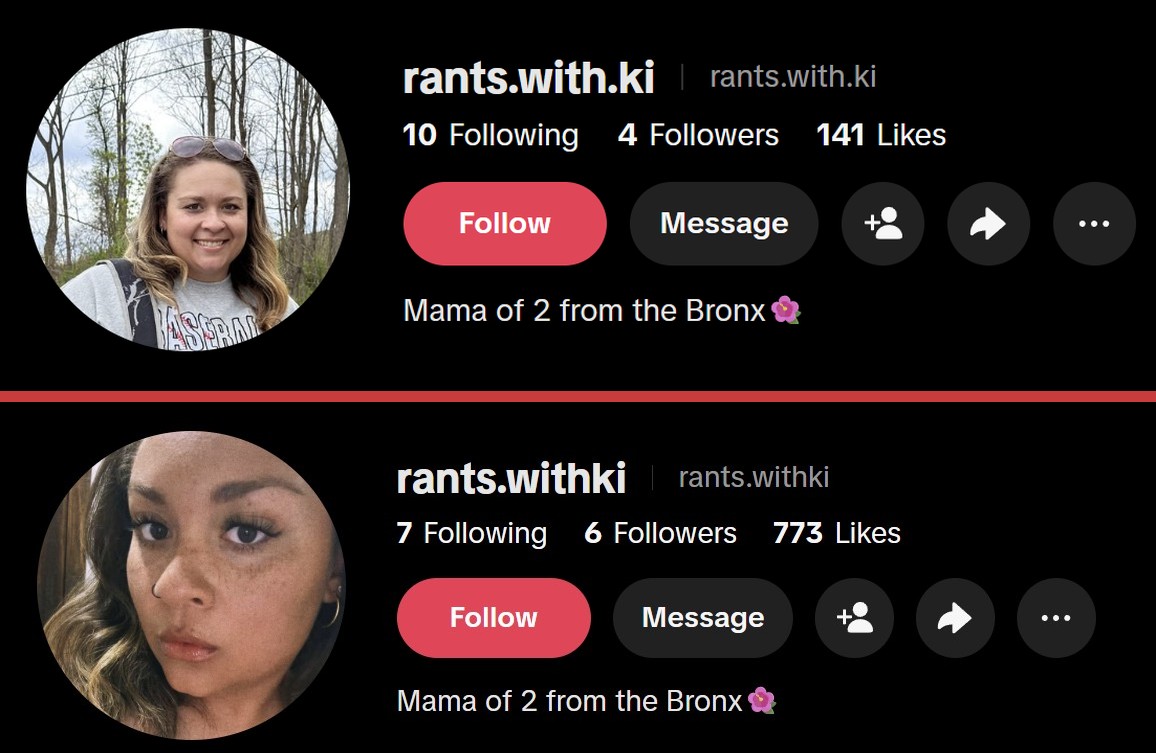
Two different people. Two different accounts. One biography, character for character.
One hundred and thirteen accounts is not one hundred and thirteen people
A caution that cuts against the headline number, and it belongs here rather than in a footnote. Several confirmed members are the same operator running more than one persona — four handle families in all, one of them three accounts deep. The clearest is a pair that publishes the same contact address on both profiles, toolie.xo@gmail.com. The account count is a measure of deployed infrastructure, not of headcount. The number of human beings behind this network is smaller than one hundred and thirteen, and this report does not attempt to say by how much.
That cuts both ways, and the second direction is the one that matters for enforcement. One person operating four labeled personas is not four creators making an honest mistake about disclosure — it is a single actor maintaining four separate fictions at once.
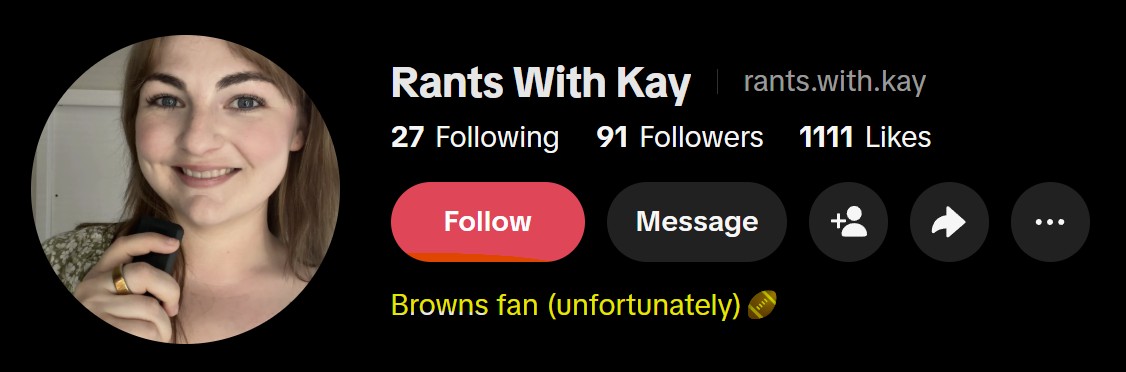
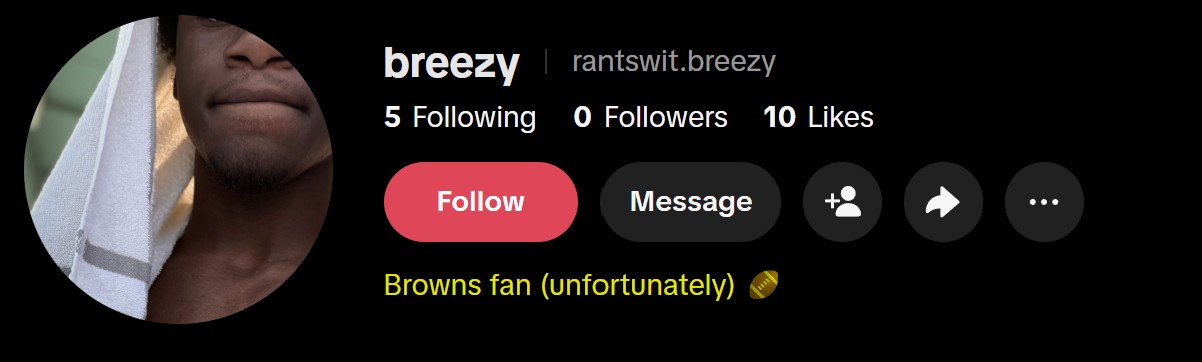
Left: rants.with.kay, 91 followers. Right: rantswit.breezy, 0 followers, created twelve days later. Same bio, same emoji, same parenthetical.
The templates underneath
Six writing formulas recur across otherwise unrelated handles.
The bio and handle evidence
The "born and raised" formula is the only linguistic thread crossing from the Ohio cell into New York — the follow graph separates those two almost completely, but the persona writing does not.81
The expansion made this formula more visible, not less. "Born and raised" (or "born and bred") now appears in ten biographies across seven states, each swapping in its own city — Manhattan, Detroit, Austin, Charlotte. The localization is real; the sentence holding it is not. The Texas cell adds a second frame of its own, three accounts opening "just yapping about" and varying only the object: the world, whatever, Texas.
And one pair that is almost certainly one person. talkswithharv reads "talking about the things that matter! Austin, Texas"; harvtalks reads "talking about the things that matter! Austin, Texas born and raised". Same opening sentence, same city, same first name inverted across the handle, created eight days apart. talkswithharv follows harvtalks. This is the clearest instance in the roster of one operator running two accounts, and it is the reason the headcount caveat above matters.82
What this does not prove. "Born and raised" and "Mom of two" are ordinary English, and neither frame is evidence on its own. No account is placed in this network on bio wording alone — every one also had to clear the follow-graph threshold. The templates corroborate; they do not carry the claim.
The same handle, the same content, twice
Every one of the 113 handles was checked at the identical address on instagram.com/<same username> — no third-party identity tool required. Where no account exists, that negative is recorded rather than left blank, so the rate below has a complete denominator. And because a matching handle is not by itself a matching person, each account found was then tested against its TikTok twin on bio text, post count and profile photograph before being called a mirror. Then the two profiles were compared directly: bio text, profile photograph, and post count.83
Correction: why the mirroring rate fell
Correction, and why the number went down. An earlier version of this report put the mirroring rate at 83%. That divided by the handles checked at the time (49 of 59), not by the whole roster. Checking all 113 — and recording the negatives — gives 73%. The rate fell because the denominator got honest, not because the network changed.
The follow list is not social. It is targeting.
These accounts follow a lot of local media, restaurants, realtors and neighborhood pages, and the obvious reading is camouflage — dressing the profile so a human visitor believes the persona lives there. That reading is probably too small. The operator says what the follows are actually for, in its own pitch:
"like geo-targeted advertising, except we're using the TikTok and Instagram algorithms to put engaging organic content directly in the feeds of people who live there." Drumbeat, describing its own method84
Following local accounts is one of the clearest locality signals available to a recommender system. On that reading the follow graph is not a social artifact at all — it is an input to the targeting, doing the same job as the state in the bio and the local utility in the script. The persona follows Ohio accounts so the algorithm files it as Ohio and serves it to Ohioans.85
The follow data supports this. Comparing the external follows — everything outside the network itself — accounts in the same cell overlap far more than accounts in different cells:
| Comparison | Account pairs | Mean overlap | Pairs sharing 3+ |
|---|---|---|---|
| Same cell | 499 | 0.023 | 140 |
| Different cells | 2,504 | 0.001 | 19 |
Same-cell accounts share outside follows at twenty-three times the cross-cell rate, and that is on five times fewer pairs. Ohio personas follow the same Ohio accounts as each other; Georgia personas follow the same Georgia accounts. What that describes is a starter list issued per cell — not twenty-two people who independently discovered the same neighborhood pages.
And the lists are mostly not news. The most-shared outside follows in the Ohio cell are ordinary local personal accounts — a campus-life page, several Columbus individuals — carried by nine to twelve personas each. They are named nowhere in this report, because they appear to be uninvolved local people whose only connection is being on someone's list. The pattern matters; their identities do not.
A lead tested and retired
This retires a lead, and it is worth saying so. One outlet, couriergeorgia, is followed by eight roster accounts — more than any other news outlet in the network, where nothing else exceeds two. Taken alone that looked like a relationship worth chasing. Measured properly it is not: within its own cell it is tied with an unrelated local Atlanta account, both on seven; the Texas and North Carolina cells follow their equivalent outlet zero times across nineteen accounts; and it is cited as a source in four posts out of 9,261. It is one entry on Georgia's locality list. No inference about funding, ownership or direction is drawn from it, and none is supported.86
Why some cells are harder to enumerate
Two shapes of account, and it changes how findable they are. Sweeping the Instagram graph out from members across the state cells showed the cells are not built alike. Some accounts follow almost nothing but each other — oliviainohio follows ten accounts and five are network members or the operator itself. Others follow almost nothing but local camouflage: kailyn.moyer's 26 follows are Pittsburgh news, realtors and food pages with no network members at all, and annacole5950's are Raleigh tourism and business accounts. An investigator who happens to start on a camouflage-heavy account finds nothing and concludes the cell is small. Starting one account over surfaces half the network. The apparent size of this operation depends heavily on where you begin, which is a further reason to read 113 as a floor.
Why the method matters more than the correction
Why the method matters more than the correction. A follow graph and a handle-match test answer different questions, and the second one inherits an assumption the first does not. Checking instagram.com/<same username> can only ever find mirrors that chose the same username; it is structurally blind to the ones that did not, and it returns a confident negative either way. That is the most dangerous kind of measurement error — not a missing number, but a wrong one that looks complete.87
What the posting clock rules out
Which corpus this section uses
Which corpus this is. This section plots the 6,048 TikTok posts for which an exact publication timestamp could be recovered — the whole TikTok catalog, not the 542-post sample an earlier version of this section relied on. Instagram is deliberately excluded here: a mirrored post is the same human action seconds later, and counting it twice would distort both the hour profile and the gaps between posts.88
Posting volume over time, one row per cell. Taller and darker means more posts in that week.
Density, not synchronization, is the signal here. Accounts sustain one to three posts a day for weeks — the published quota is 30 posts a month — but they do not fire in unison.89
When they post
All 6,048 TikTok posts by hour of day, US Eastern.
93% of all posts land between 08:00 and midnight Eastern, on a broad plateau that runs from late morning to midnight rather than a single evening spike. This is a finding that cuts against a foreign-operation reading: the network keeps American waking hours, with the heaviest output after the American working day. It is consistent with real US-based people posting around a job — which is exactly what a paid domestic creator program would produce.
The timing analysis
I also tested for batch uploading and largely did not find it: only 4.0% of consecutive posts are less than ten minutes apart, now measured across 5,942 intervals rather than a few hundred. The figure did not move when the corpus grew elevenfold. Three accounts stand out — lily.cather (54% of its intervals), rants.withgloria (38%) and annacole5950 (29%) — and whocanaffordthis publishes in pairs 77 to 166 seconds apart before going quiet for twenty hours. But it is not a network-wide behavior, and I am not presenting it as one.
Real people, new accounts, a supplied script — and no disclosure
Every structural finding below is directly verified from platform data. The commercial mechanism is documented from the operator's own published material. The one thing I do not resolve is which client paid for it.
Where this report stands on each question
Established
- Drumbeat Labs LLC exists, is incorporated, and publishes its own operating model90
- Creators are recruited, paid per post, and instructed to make new accounts91
- 113 accounts across ten states, 7,519 campaign posts, 63.4M views92
- 8,408 of 8,463 persona posts carry no disclosure93
- Partisan intensity varies by state on one infrastructure
Assessed
- The accounts are coordinated rather than coincidental — follow graph, duplicated bios, provisioning waves94
- Content is supplied rather than independently written
- The network is larger than 113; every round of enumeration has raised it
Not established
- Who paid. No contract, invoice or payment record was obtained
- Whether one client or several stand behind the campaign
- How many human beings operate the 113 accounts — fewer than 113
- What competitors running the same model would add to the total
Hover or tap any finding for the evidence behind it.
- The four accounts in the video were batch-created. Proven · High + details Platform creation timestamps: 30 Jul 08:09, 30 Jul 22:20, 30 Jul 23:46, 31 Jul 18:41 UTC — a 34.5-hour span. Confirmed independently by two collection sources agreeing to the second.
- Three pairs of accounts carry byte-identical biographies. Proven · High + details Browns fan (unfortunately) 🏈 appears on both @rants.with.kay and @rantswit.breezy. the affordability crisis is real and alive, especially in Ohio! let's chat — 74 characters — appears on both @ohioinfo and @newswithchloe. And Mama of 2 from the Bronx🌺 appears on both rants.with.ki and rants.withki — handles separated by a single full stop, created six days apart.95
- Twenty-five of twenty-seven handles are mirrored on Instagram. Proven · High + details Twenty of those publish a post count within one of their TikTok count; eleven match exactly. That is one content stream pushed to two platforms, not two accounts run in parallel.
- One persona's Instagram name still contains its staging note. Proven · High + details @rants.with.rae's Instagram display name reads Rae-not active yet- while its TikTok side runs 22 posts to 39 followers. Nobody arrives at that name through personal use.96
- The follow graph splits into ten state cells. Proven · High + details 799 internal follow edges across 113 accounts in ten states; the two most-followed nodes in the whole graph are disclosed paid ambassadors. The New York personas instead follow real local food and lifestyle creators — better camouflage, and far harder to detect.97
- Accounts in the same graph disclose that they are paid. Proven · High + details @kamyapss and @nimaiyaps state "building @Drumbeat" / "DrumBeat Ambassador" in bio; @kamyapss recruits publicly — "if you want to get paid to talk about local Ohio issues like this, comment down below LOCAL." @loladrumbeat runs the Georgia equivalent.
- The published method explains every anomaly here — and the paid ambassadors are wired into the network. Probable · High + details Drumbeat Labs LLC publishes its process: creators "establish new TikTok and Instagram accounts and post 2-3 times daily with provided content inspiration," $500 per 30 posts, with affordability among its named campaign verticals. Eleven separate observations follow from that one paragraph. Beyond method resemblance, the four self-declared paid ambassadors are directly follow-linked to 12 of the undisclosed personas across 28 edges, including 7 mutual pairs, and one of them follows the company's own TikTok account. A competitor merely copying the playbook would not be wired in like that. Still assessed rather than proven: no contract or payment record was obtained. See the attribution chain in §02.98
- Persona accounts disclose on 55 of 8,463 posts — 0.65%. Proven · High + details All 6,048 TikTok posts return the platform's branded-content flag as false; no #ad or sponsorship marker appears in any caption or persona bio; and no paid-partnership label was found on any of the 25 mirrored Instagram accounts. This breaches TikTok's Branded Content Policy — which also bans political branded content outright — and Meta's mandatory paid-partnership labeling.99
- It breaks both platforms' rules, and may break election law. Proven · platform rules Open · statute + details Undisclosed paid posting breaches TikTok's Branded Content Policy — which bans political branded content outright — and Meta's mandatory paid-partnership labeling. Whether it also breaches Ohio and New York disclaimer statutes depends on whether the paying client is a political committee or a nonprofit, which is not established. See Annex C.
- What is documented here is a fragment of the operation. Proven · operator's own figures + details Drumbeat's founders state publicly that the company has generated "70M+ cost-efficient views… across six pilots" in nine months, plus 2.3 million views for a single nonprofit partner in under seven days from 70+ posts. This report maps ten state cells and 9,261 posts. Every enumeration method used here also has a known blind spot — see §09. The network is larger than 113; how much larger is not established.100
- Who funded the campaign. Open + details Drumbeat says opportunities come from "partner organizations." None are named publicly, and no first-party contract, brief or payment record was obtained. This single unknown is what decides whether the campaign is merely against the rules or actually unlawful.101
The accounts, their timing, their duplicated assets, their mirroring and the disclosed recruiter layer are verified. The link from these personas to that specific platform is assessed. The paying client stays open.
Everything above is the part that was findable
Investigations tend to present what they found as though it were the whole. This one cannot, and the reasons are worth setting out — because each of them is a place where more of this network is sitting undetected.
| Gap | What it means | Scale |
|---|---|---|
| The operator claims six pilots | Drumbeat's own launch post: "70M+ cost-efficient views on TikTok, Instagram, and YouTube across six pilots" in nine months. This report identifies ten state cells | Possibly half the program unmapped |
| YouTube was never examined | The same post names YouTube alongside TikTok and Instagram. No YouTube collection was attempted here at all | An entire platform unexamined |
| Reactivated accounts are invisible | Enumeration leaned on batch creation dates. kelsie.explains was registered in 2021 and switched on in August 2026 — found only because a reader flagged it, not by any method used here | Unknown; structurally undetectable at scale |
| Isolated personas leave no graph trace | just.a.maine.mama has zero follow edges to any member. It surfaced only because it was created eleven minutes after rants.with.p. A persona created outside a batch window and not interlinked would be invisible | Maine found by luck; other states may exist the same way |
| Other verticals, same roster | The same disclosed ambassadors follow accounts running unrelated campaigns — non-toxic household products, Atlanta nightlife. Affordability appears to be one client among several | Other campaigns entirely out of scope |
| Ten personas are not mirror-audited | An earlier Instagram audit covered only the 27 handles known at that stage; the current figures cover the full 113-account roster | 49 accounts verified; ~77 estimated |
| Expansion never stopped yielding | Enumeration was halted because the report had to ship, not because the graph ran dry. The last three accounts checked — mads_ventures, news.with.whit, ryansays12 — all confirmed, with 7 to 10 inbound follows each. ryansays12 follows six accounts in total and four are network members | The boundary of this network has not been found |
| Two accounts changed state during collection | beckyknowsbest ("local opinionated woman shares Ohio news", 4 followers) was live in the follow graph on 15 August and returned "this profile does not exist" from two independent tools hours later. livingwithpaigemarie was recorded with 45 posts and re-checked at zero. Whether deleted by the operator, by the creator, or by the platform is not visible from outside | Live networks are not static evidence |
| Only one competitor's playbook was traced | Drumbeat publishes its method. Any firm running the same model would produce the same observables — and would not appear anywhere in this report | Unknown number of comparable operators |
Sources: 102
The four accounts in that video were not a network. They were four of thirty-four then known, in one of four states then known — the roster now stands at 113 across ten — on one of three platforms, run by one of an unknown number of firms — and I found them because somebody happened to post a compilation. Every number in this report is a floor. None of them is a total.
What this network actually is
Walking the Instagram follow graph out from confirmed members turned up a tight cluster of accounts that are wired into this network by the same standard applied everywhere else in this report — two to four inbound follows from confirmed members — but which are not posting about the cost of living at all. Reading what they do post changes the shape of the thing.
| Brief | Inbound | What the content is |
|---|---|---|
| Cost-of-living grievance the 113 accounts in this report | — | Rent, groceries, utilities, wages. Localized per state. No candidate, no bill, no ask |
| Consumer lending talkswithlk (3 inbound) | 3 | A single network-linked account naming a consumer lender inside its cost-of-living posts. Two further accounts advertising the same lender were examined and excluded — see the note below |
| Immigration & national unity talkswithquis · naysarants | 4 | "Immigrants are more than just fast food workers" · #immigrantsmakeamericagreat · #250years · #cometogether |
| Progressive issue advocacy clearlygino · clearlyleaa · vgoodrants | 4 | Abortion rights, ICE, Christian nationalism, student debt. Names bills. Has explicit calls to action — "contact your senator now!!" — and reaches 655,014 views on a single post |
Sources: 103
The same cluster carries several unrelated briefs, and one of them argues the opposite politics of another. The cost-of-living cell in New York attributes blame to "MAGA Republicans"; clearlygino campaigns against ICE and Christian nationalism; talkswithquis posts national-unity content telling people to stop being divided; talkswithlk sells loans. These are not the positions of a movement. They are the outputs of a marketplace.
What is missing, and what is not claimed
That is the most useful correction this investigation has produced about its own subject. It is tempting to read 113 accounts running one message across ten states as a campaign with a hidden sponsor and a single goal. The follow graph does not support that. It supports something more mundane and more durable: a standing distribution layer of rented, undisclosed personas that will carry whatever brief is bought this month — grievance in the spring, a lender at Christmas, immigration in March. The cost-of-living campaign is a customer of this infrastructure, not the whole of it.104
An adjacent operation, examined and set aside. Two accounts — graceyy.chats and kaelinrants, created 381 minutes apart on 20 December 2025 — advertise a consumer lender, credi.fi, inside cost-of-living framing, using the same persona shell and fixed hashtag blocks as this network. They are not counted here, and on the evidence they are a different operation: neither clears the follow threshold (one inbound and zero respectively), graceyy.chats carries no state or city targeting in 48 posts where geo-targeting is this network's defining trait, and the roster itself contains zero commercial promotion of any kind. Identical tradecraft is not identical operators — the same point this report makes about @Get Real News in Pennsylvania. Logged as a lead, not a finding.
What this does not establish. That one operator runs all of these briefs; that Drumbeat brokered any of them beyond the model it publishes; or that the clients are connected to one another. Creator marketplaces sell the same creators to unrelated buyers, which is the ordinary explanation and the one this report favors. The accounts above are not counted in the 113, because they are not running the campaign this report measures — they are named here because they share its infrastructure, and because a reader deciding what this network is deserves to know that the cost-of-living content is one product on a shelf rather than the shelf itself.
The clearest evidence that this is incomplete is what happened while writing it. On 15 August this report described 94 accounts across nine states and measured 24.6 million views. A single further round of enumeration — one tip, followed by two follow-graph pulls — produced 113 accounts across ten states and 63.4 million views. Texas went from three accounts to fifteen. Iowa went from nothing to one. Nothing about the network changed in those hours; only the amount of it that had been looked at.105
Enumeration is not converging. Each round has ended with more unexplored edges than it started with: the newly added Texas accounts alone follow roughly fifty accounts that have not yet been checked. A search that keeps returning new members at this rate has not reached the boundary of the thing it is searching. 113 is a floor produced by the effort spent, not an estimate of the network's size, and no figure in this report — reach, post count, state count — should be read as final.
The technical annex
Everything above is the finding. Everything below is how it was established: what was collected, what the thresholds were, what was tested and rejected, and where this account of the network is weakest. It is here rather than in the body because a reader deserves the story first and the workings on request — but the workings are the reason the story stands up, and nothing in them is hidden.
How the reach figures were built
The 63.4 million figure counts campaign content only. This is what was excluded, and what the number cannot bear.106
What counts, and what was thrown out
Fourteen of these accounts existed before the campaign and have back catalogs of ordinary personal content. Counting that would inflate the number with videos that have nothing to do with the operation. So every post was classified on what is actually in it — machine-read scene descriptions capturing on-screen text, plus the caption — and only posts about affordability, rent, groceries, utilities, wages, taxes, healthcare, childcare, student debt, data centers or public spending were counted.107
| Basis | Posts | Views | What it is |
|---|---|---|---|
| Everything on these accounts | 9,261 | 69,746,576 | the full retrieved catalog, both platforms |
| less non-campaign content | −1,709 | −6,378,297 | personal back catalog on pre-existing accounts |
| less unreadable posts | −33 | −1,871 | no caption, no on-screen text, no description — not counted either way |
| Campaign content | 7,519 | 63,366,408 | the figure used throughout this report |
Only 33 posts in the entire catalog cannot be read at all — no caption, no on-screen text, no description — and between them they carry 1,871 views. An earlier version of this report had to exclude 546 posts and 4.7 million views on those grounds; reading the video frames rather than the captions removed almost all of that doubt. The 33 are excluded, which makes 63.4M a floor rather than an estimate, but it is now a floor with very little air beneath it.
Reading the on-screen text, and why the platform’s own text could not be used
These are talking-head videos with the argument written across the frame. Any measure of what the network says therefore depends on reading that text, and the obvious source for it turned out to be unusable.
TikTok exposes a machine-written scene description for some videos. It is good — it renders on-screen text in about four of every five videos where it exists — but it exists as a function of recency, not content. Coverage across this corpus runs at zero percent for every month before January 2026 and climbs to 86 percent by August 2026. The same pattern appears account by account: some accounts carry it on every post, others on none, according to how a collection run happened to be ordered. TikTok’s subtitle and transcription fields behave the same way and return empty for all 2025 posts, in profile collection and in single-video collection alike.
An instrument like that cannot be used to compare anything. A theme measured with it would appear to grow through 2026 for the sole reason that the instrument improved, and an account would appear more on-message than its neighbor because its posts were read more thoroughly. Cross-state, cross-account and month-on-month comparisons built on it would be measuring collection, not behavior.
What is used instead is optical character recognition of each video’s cover frame. This is indifferent to a post’s age: it applies the identical operation to a September 2025 post and an August 2026 post, and it returns the words as written rather than a paraphrase. Where the machine description said a video discussed surveillance, the frame itself reads “flock is evil”. It runs on 99.9 percent of the TikTok catalog — every post holding a retrievable cover image.108
What that still does not reach. The cover is one frame. Where a video’s text changes as it plays, this captures the opening card and not the rest, so it reads the subject reliably and the full argument only sometimes. Instagram publishes no equivalent field and no cover was retained for its posts; because the two platforms carry the same videos, an Instagram post inherits the reading from its TikTok twin where the pair can be matched on handle, caption and date, and stays caption-only where it cannot. Both limits push the same way: they can only cause campaign content to be missed, never invented. Every figure here is a floor.
A merge fault, found and corrected. Posts collected in more than one pass were being reconciled by choosing whichever record looked richest, rather than by combining their fields. Where an early pass had returned a post with its caption stripped, that blank record could survive a later pass that carried the caption intact. The fault concealed the text of several hundred posts, among them one carrying 1.6 million views and the caption “they don’t want us to talk about this #costoflivingcrisis” — unambiguously on-topic, and counted as unreadable. Records are now combined field by field, and the posts that remain genuinely textless number in the tens rather than the hundreds.
What these numbers are not
| Limit | Effect on the figure |
|---|---|
| Views are not people | A TikTok view is counted on near-instant playback. These are impressions delivered, not minds changed. This report makes no claim about persuasion, turnout or vote effect |
| Audiences overlap | Several operators run multiple personas and the accounts follow each other, so unique people reached is lower than 63.4M |
| Eight accounts returned nothing | Of the 113 accounts, 104 yielded post data; the rest were private, empty or removed at the time of collection. Their reach is not in the total |
| The roster keeps growing | This figure was 24.6M at 94 accounts and is 63.4M at 113, after a single further round of enumeration. Every round so far has raised it. 113 is what could be proven, not what exists |
| The operator claims more still | Drumbeat's own published figure is 70 million views across six pilots. Measured here: 63.4M across the findable part of a ten-state footprint — the same order of magnitude, independently arrived at |
Sources: 109
Sixty-three million views is the measured floor for content almost none of which was labeled as paid. Reach is not persuasion. But it is the thing that was bought, and it is the thing that was delivered.
They are not selling anything either
One test worth running against a paid network is whether the accounts monetize the audience they are building. They do not. All 9,261 collected posts — 6,048 on TikTok, 3,213 on Instagram — were searched for the ordinary machinery of creator commerce. The result is a clean zero.110
| Commercial signal | Posts | Notes |
|---|---|---|
| Partner or advertising hashtags #ad, #sponsored, #partner, #affiliate, #gifted | 0 | None, on either platform |
| Affiliate mechanics "use code", "link in bio", referral, swipe up | 0 | None |
| A named financial product being recommended | 0 | Ten posts name a fintech brand; on inspection all ten are false positives — six are the word "chime" in an audio description or "wanna chime in", one is the verb "affirm", and three cite LendingTree as the source of a statistic about Georgia auto loans, not as a product |
This sharpens the central observation rather than softening it. The purpose-built personas have audiences, they post daily, and across 5,910 campaign posts they never try to sell anything — no code, no link, no product. (The pre-existing creators do carry ordinary brand work: nine posts in the corpus are flagged consumer deals, all on one account. Not one is political.) A creator building a following for their own benefit monetizes it; that is the entire economic logic of being a creator. These do not, because the audience is not the asset being sold. It has already been sold, to whoever commissioned the message. The absence of a commercial ask sits beside the absence of a political one, and both point the same way.
Which Instagram number this uses, and why it is the smaller one. Instagram reports two figures per video. videoPlayCount counts plays including autoplay and loops; videoViewCount counts views. On the same posts in this corpus the play figure runs 2.3 to 2.9 times higher — the single largest post reports 9,033,546 plays against 3,215,486 views. Every Instagram figure in this report uses the view count, the smaller and more TikTok-comparable of the two. Using plays instead would put the Instagram total at 44.6 million rather than 17.1 million, and the headline at roughly 88 million. That number would be defensible on Instagram's own labelling and is not used here.
A collection gap, corrected. Until 17 August the Instagram figures rested on 44 of the 88 confirmed mirrors — the others had been identified but never had their posts pulled, so their reach sat outside every total. Collecting the remaining 44 added 2,015 posts and moved the campaign figure from 30.4 million to 43.3 million. Reading the on-screen text then moved it again, to 63.4 million. The first correction is a reminder that a mirror confirmed is not a mirror measured; the second, that a post collected is not a post read.111
A gap in the keyword set, found and closed. The anchor list was audited against the posts it rejected. It was missing renters, bare daycare and the cost of… construction — core cost-of-living vocabulary rather than generic price words. Adding them moved the campaign figure by 0.1%, fifteen posts and 78,217 views, every one of them plainly on-brief. Bare economy was tested at the same time and deliberately left out: it pulls in a post about media bias and one about American exceptionalism, neither of which is affordability content. The rule stays narrow on purpose — an earlier, looser version of it inflated the total by roughly sixty percent.
How accounts were tested before being counted
Every account here had to clear a follow-graph threshold, and every cross-platform mirror had to clear a three-attribute identity test. Both are set out here, including the cases that failed them.112
A matching handle is not a matching person
Usernames collide. Every one of the 82 accounts found was therefore compared against its TikTok twin on three independent attributes — bio-text similarity, post-count proximity, and a perceptual hash of the profile photograph. Two or more attributes agreeing is treated as confirmation; one is probable; none is a handle and nothing else.
| Verdict | Accounts | Basis |
|---|---|---|
| Same persona confirmed | 49 | Two or more attributes agree. erin.d.930 167 posts against 167. karonde.yaps 47 against 47 with an identical bio. paigerants3 and newsfeedfemi carry the byte-identical profile photograph. These are one asset on two platforms |
| Probable | 12 | One attribute matches strongly, another diverges — usually a different posting cadence per platform. talkswithharv has the identical bio sentence with 27 Instagram posts against 69 on TikTok |
| Reserved, never used | 8 | The matching handle is held with zero posts on it — bergen.ellis, itsjenntucker, heyitssarahtx, rantswithbec, rantswithsaum, redhead.rachel, chels.chats, nimaitalks. The name was claimed and never used |
| Handle only | 13 | No attribute corroborates. Some are simply divergent; four are clearly different accounts — rootedbean's Instagram is a houseplant diary, mads_ventures' reads "joy is an act of resistance". Those read as the operator's own personal account rather than a campaign mirror, and are excluded from the verified count |
Sources: 113
That last row is the reason this test exists. Four accounts would have been counted as mirrors on handle alone, and all four are something else — most likely the real person behind an ambassador account, using Instagram as themselves. Counting them would have inflated the mirroring rate and, worse, implied campaign content on accounts that are not carrying any.
Three rates, and they are not the same number. 78% of the roster (88 of 113) has an Instagram account. 60% (68 of 113) is corroborated as the same persona on at least one attribute. 50% (56 of 113) is confirmed on two or more. An earlier version of this report quoted only the first of those and called it a mirroring rate; the honest headline is the third. The difference between 73% and 44% is the cost of checking, and it runs in the direction that makes the network look smaller, not larger.114
Six mirrors are claimed but empty — and that is its own finding. Someone registered the name and never posted to it. It is the signature of provisioning ahead of need: the handle is reserved so the persona can be pushed to a second platform later, and for six accounts that step has not happened yet.
Mirroring is not uniform, and Texas is the outlier. Ohio has an Instagram account at 88% of its handles (24 of 27) and the ambassadors at 83%. The Texas cell — the newest and fastest-built — sits at 53% (8 of 15). The cells that have existed longest are the most completely deployed, consistent with the second platform being a later step in a standing process rather than part of the initial build.
| Cell | IG account exists | None | Rate |
|---|---|---|---|
| Ohio | 24 | 3 | 88% |
| Disclosed ambassadors | 10 | 2 | 83% |
| Pennsylvania | 3 | 1 | 75% |
| North Carolina | 5 | 2 | 71% |
| Georgia | 19 | 9 | 67% |
| Michigan | 4 | 2 | 66% |
| New York | 4 | 2 | 66% |
| Wisconsin | 3 | 2 | 60% |
| Texas | 8 | 7 | 53% |
| Iowa · Maine | 2 | 0 | 100% |
The operator mirrors too, and says the quiet part out loud. instagram.com/hellodrumbeat exists and states the business in one line: "Connecting creators with paid opportunities to talk about stories, news, and issues they care about." The company describes the arrangement plainly on its own account. None of the personas do.115
Ten accounts match on all three at once — identical bio, identical photograph, and post counts within two: paigerants3, rants.with.kay, its.emma.in.ny, hunterrrr972, oliviainohio, rantswithivy, talia.smith333, kelsie.explains, karonde.yaps and lexigray181. That is not a person who happens to use two apps. That is one asset, deployed to two platforms.
How the photo test works, and what it does not prove. Each pair was compared with a perceptual difference hash — a measure of whether two images are the same picture, robust to resizing and re-compression but not to a different photo of the same person. A score of 0 means the identical file. The 37% figure is therefore a floor on visual mirroring, not a ceiling: accounts scoring "different" often still show the same individual in another shot, which this test deliberately will not count.
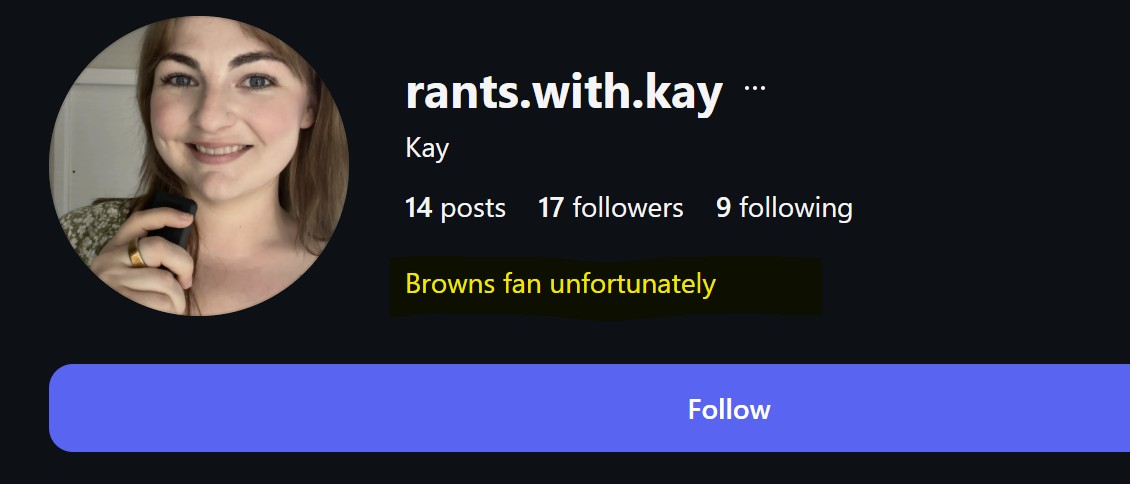
Nineteen of the twenty-five mirrors sit under forty followers. @jazzmyneohio has published 54 Instagram posts to an audience of seven. Sustained daily publishing to nobody is only rational if payment is per post rather than per result — which is the compensation model the platform publishes.
The handle is not always the same handle
Everything above assumed the mirror sits at the identical username, because that is what the network mostly does. Walking the Instagram follow graph out from confirmed members — a different route to the same question — showed the assumption is wrong often enough to matter. Six accounts recorded above as having no mirror, or an empty one, in fact have an active mirror under a slightly different handle.116
| TikTok | What matches | |
|---|---|---|
| livinlifewithjo_ | livinlifewithjo | The Instagram bio names the TikTok account outright: "don't mind me i'm just yappin · tt: livinlifewithjo_". Self-declared, no inference required |
| jill33112 · "Just yapping about Texas" | yappinjill · "just yappin about Texas" | Same cactus emoji, same sentence, 135 posts against 136 |
| tiffany.lakes · "Just yapping 📍htx" | tiffany.lakess · "Just yapping 📍htx" | Identical bio, 45 posts against 44 |
| heyitssarahtx | heyitssarahtxx | The same-handle Instagram account is an empty placeholder; the working mirror is at the doubled letter, with 75 posts |
| graceisgabbing · "ohio born and raised!" | gabwithgracie · "📍ohio" | Same first name, same verb, 66 posts against 67 |
| nnicoletalks | nicole.talks | Both carry the same distinctive phrase set — "let's talk about Ohio", "college educated", "activist", "model", "professional yapper". 101 posts against 89 |
Sources: 117
This cuts one way only. Every correction found by this method adds a mirror that same-handle checking had scored as absent. The published rates are therefore floors: the true mirroring rate is higher than 78%, and the true verified rate higher than 50%. How much higher is not established, because exhaustively testing handle variants for all 113 accounts has not been done.118
Two accounts that are not cells
Maine and Iowa appear in every table in this report as though they were cells like the others. They are not. Each is a single account, and neither is held in place by the follow graph that defines every other cell here. They are counted, but they rest on a different kind of evidence and a reader should know which.
| Account | Follow links | What actually places it here |
|---|---|---|
| just.a.maine.mama Maine · 10 posts · 39 followers | 0 | Provisioning, not follows. Created eleven minutes after rants.with.p — one of the four anchor accounts this investigation began with. For comparison, the anchor cluster itself spans 34.5 hours. Its own following list was collected and it follows no member; no member follows it. Content is on-brief: Portland rent, Hannaford grocery totals, tariffs on imported food |
| itsjenntucker Iowa · 61 posts · 273 followers | 1 | Four weak signals, no strong one. One inbound follow (jennopalis); created inside the May 2026 provisioning wave; the bio "Mom of 2 in Iowa" matches the template carried by eight other accounts; and a verified Instagram mirror at the same handle. 220,104 views of Iowa cost-of-living content |
Sources: 119
An eleven-minute creation gap is not weaker evidence than two follows — it is different evidence. Accounts can follow each other for many reasons; being registered eleven minutes apart on the same afternoon, and then posting the same kind of content in a different state, is a coordination signal that is hard to produce by accident. It is also the reason this account was found at all: it has no graph trace, and nothing but the timestamp connected it to anything.
And there is no cell behind either of them. A hashtag sweep of Iowa and Maine cost-of-living content since April 2026 returned 100 posts and not one further persona account — the rest is sorority recruitment, the Des Moines Register, local photographers, state-fair coverage. Every other state in this report has between four and twenty-eight interlinked accounts. These two states have one apiece and no internal structure, so "the Maine cell" and "the Iowa cell" overstate what was found. Read them as two isolated accounts that the evidence places inside a network built elsewhere.
What would settle it. For Maine, any follow edge in either direction, or a second Maine account in the same provisioning window. For Iowa, one more inbound follow. Both accounts are live and both are worth re-testing as more of the network's follow graph is collected — 27 of the 113 accounts still have none.
The legal reading, and its limits
Platform rules, FTC endorsement principles, federal and state election law, and the coordinated-inauthentic-behavior framing — what each reaches, and what it does not.
The FTC principle
The FTC's Endorsement Guides (16 CFR Part 255, revised 2023) rest on a single idea: where an endorser has a material connection to whoever is behind the message — money, free product, employment — the audience has to be told, clearly and unmistakably, in the post itself. Payment of $500 per thirty posts is a material connection by any reading. Judged against that principle, this network fails completely.120
Whether it also constitutes a legal violation is a narrower question, and I am careful about it here for a reason. The FTC Act reaches deceptive practices "in or affecting commerce," and its jurisdiction is over commercial speech; pure political or issue advocacy has historically sat outside it. If the paying client is a nonprofit running issue advocacy, the Guides are a poor jurisdictional fit even though the conduct is exactly what they exist to prevent. That gap is not a technicality to be waved away — it is the finding. The operator's own marketing calls the product "like geo-targeted advertising" and claims it beats "paid advertising" on trust, while the arrangement is structured so that neither advertising disclosure rules nor election disclaimer rules clearly bite.121
Election law: where the exposure actually sits
Undisclosed paid political communication is regulated in the United States — but the rules bind the payer, and they turn on who that payer is. That is the single fact this investigation could not establish, and it is why the report stops short of calling the campaign illegal. Set out plainly, so the test is visible:122
| Rule | What triggers it | Status here |
|---|---|---|
| TikTok Branded Content Policy | Any post under a commercial relationship; political branded content banned outright | Breached. 6,048 TikTok posts, zero branded-content flags. Not conditional on anything |
| Meta Branded Content & Inauthentic Behavior policies | Mandatory "Paid partnership" label; no misleading as to origin or purpose | Breached. No label on any of the 3,213 collected Instagram posts |
| FTC Endorsement Guides (16 CFR 255) | Material connection between endorser and sponsor, in commercial speech | Fails the principle outright. Legal reach depends on whether the content is deemed commercial rather than political speech |
| Federal disclaimers (52 U.S.C. §30120) | Express advocacy for or against a clearly identified federal candidate, solicitations, electioneering communications | Largely not triggered — "MAGA Republicans" is a party label, and organic posts are not "public communications" placed for a fee |
| Ohio ORC §3517.20 · New York Election Law §14-106 and the Democracy Protection Act | Disclaimers on paid political communications, including digital, by candidates, committees and certain independent spenders | Conditional — and this is the live question. Bites if the payer is a candidate committee, PAC or independent expenditure committee. Likely does not if the payer is a 501(c)(4) running pure issue advocacy |
Sources: 123
Campaign finance: the internet exemption, and the one route around it
Campaign-finance law is where most readers expect this to land, and it is worth being precise about why it mostly does not — because the reason is itself the story.
Federal reporting rules attach to a "public communication." Under 11 CFR 100.26 that term covers broadcast, cable, satellite, newspapers, mass mailing, phone banks and paid internet placement. Organic social posts are specifically outside it. A creator paid $500 to post on their own account is not buying ad space; nothing is "placed for a fee on another person's website." The same logic exempts this content from electioneering communication rules under 52 U.S.C. §30104(f), which reach broadcast, cable and satellite only. Independent-expenditure reporting under §30104(c) requires express advocacy — "vote against," "defeat" — and across 9,261 posts this network almost never uses it.124
So the money moves without a filing. Not through a loophole anyone had to find, but through the ordinary shape of the rules: pay a person rather than a platform, use grievance rather than express advocacy, and the federal disclosure architecture does not engage at all.
The exception is coordination, and it is the sharpest unresolved question here. Under 11 CFR 109.21, spending made in cooperation with, or at the request or suggestion of, a candidate or party committee becomes an in-kind contribution — reportable, subject to limits, and unlawful if the source is a corporation or over the cap. The content prong of that test can be met by a communication that refers to a clearly identified candidate within the pre-election window. This network does refer to clearly identified candidates: posts naming Jon Husted, and one explicitly framing "Brown's record vs. Husted's record — the Ohio Senate race." If any of that was produced in coordination with a campaign or party committee, the analysis changes completely.125
I have no evidence of coordination and am not alleging it. I am identifying the test, because it is the one route by which this conduct becomes a reportable contribution rather than an unregulated purchase — and it is answerable only by someone who can see contracts and payments. Note also that the campaign now spans ten states, each with its own disclaimer and electioneering regime; the conditional in the table below multiplies accordingly, and Ohio and New York are simply the two examined here.
So the answer to "is this illegal" is not a shrug, it is a conditional with one unknown in it: if the organization that paid for this campaign is a political committee, then a coordinated program of paid political communications carrying no disclaimer, on two platforms, across 8,408 undisclosed persona posts, is a serious problem under state election law. If the payer is a nonprofit doing issue advocacy, it likely sits outside those statutes — and outside the FTC's commercial-speech jurisdiction too, while still breaching both platforms' rules.126
That is the finding, and it should not be softened: the conduct is identical either way, the deception of the audience is identical either way, and whether it is unlawful depends entirely on a fact the public cannot see. Drumbeat names no clients. The personas name no sponsor. A regulator with subpoena power could resolve this in an afternoon; a member of the public in Columbus cannot resolve it at all.
The honest summary: this campaign breaks TikTok's rules and Meta's rules outright, fails the FTC's disclosure principle completely, and may well breach state election law — that last one turning entirely on the identity of a payer nobody has disclosed. A practice does not have to be proven illegal to be corrosive. But when the only thing standing between "undisclosed marketing" and "unlawful undisclosed political spending" is a client name that no one will say out loud, that is not a loophole. That is the business model.127
This conduct is already regulated in one of these ten states
The disclosure analysis above is not hypothetical, and it is not only federal. In June 2024 the Texas Ethics Commission voted 7–0 to require anyone paid more than one hundred dollars to post or repost political advertising to say so. That rule was in force before a single account in this network began publishing, and Texas is the second-largest cell here — fourteen accounts and roughly 18.3 million views.128
The rule was written in response to a named company. Reporting at the time identified Influenceable LLC, which had been paid to recruit social-media creators to defend the state attorney general during his impeachment. Recruit creators, supply the line, do not label the result. A regulator has already looked at that structure once and written a rule about it.
What that does and does not establish. The Texas rule reaches political advertising — communications supporting or opposing a candidate or ballot measure. The overwhelming majority of this network’s output is issue content with no express advocacy, and on the plain reading it sits outside that definition. That is not a gap in the finding; it is the finding. The content is pitched precisely where the grievance lands and the disclosure duty does not. Where these accounts did cross into candidate advocacy — the seventy-nine undisclosed posts discussed in §06 — the analysis is different, and that is the exposure worth watching.129
And the law is moving toward this conduct, not away from it. In August 2026 California was considering a bill from Assemblymember Marc Berman allowing the Fair Political Practices Commission to fine creators and committees up to $5,000 per violation, and — the operative part — to do so administratively rather than through a court process that can take months. New York’s legislature has weighed a comparable requirement. California matters here for a second reason: a California gubernatorial committee is one of only two payers this network ever named, on the nineteen disclosed posts in §06. This report takes no position on any pending bill. The point is narrower and factual: the practice documented here is already governed in one of the states where it ran, is under active legislation in others, and has a named regulatory precedent built the same way.
Call it what it is: coordinated inauthentic behavior130
The industry term for this is not "influencer marketing." It is coordinated inauthentic behavior — and this network meets the definition on every element, not loosely but precisely.131
| Element of the definition | What was found |
|---|---|
| Coordinated — assets act together under common direction | 129 verified follow edges between members; two byte-identical bios; identical hashtag blocks across accounts; one nine-beat script delivered by four personas; a supplied brief the operator advertises as "content inspo and viral hooks" |
| Inauthentic — the accounts misrepresent what they are | 24 personas created for the campaign across three waves, with no prior audience or history, presenting as spontaneous local residents while concealing paid sponsorship. One Instagram display name still reads Rae-not active yet- |
| Behavior — assessed on conduct, not viewpoint | The finding rests on account provisioning, duplicated assets, follow topology and disclosure — not on whether the cost-of-living argument is right or wrong. The same conduct carrying the opposite politics would be the same finding |
| Strategic goal | Place-based political persuasion, targeted by the operator's own description to "state, city, congressional district" |
Sources: 132
The obvious objection is that the people are real — real faces, real voices, no bot farm, no stolen photographs at the network level. That objection is worth taking seriously, and it is why this report says plainly in §09 that this is not a bot network. But it does not rescue the conduct, for two reasons.
First, the inauthenticity is in the account, not the human. "Kay, Browns fan, struggling with Ohio prices" is a constructed vehicle: created for the campaign, scripted, mirrored to a second platform, and — decisively — carrying a biography copied word for word onto another account. A persona whose bio is duplicated across two identities is not a person expressing themselves. It is a template being filled.133
Second, the precedent is settled. Meta has repeatedly removed networks it classified as coordinated inauthentic behavior that were run not by states but by commercial marketing and PR firms on behalf of paying clients, staffed by real people. "There was a real human behind the account" has never been the test. The test is whether the audience is deceived about who is behind the coordinated activity and why — and here, across 8,408 undisclosed persona posts on two platforms, they are told nothing at all.134
What distinguishes this case from the state-actor archetype is not authenticity. It is that the operation is domestic, commercial, invoiced, and advertised on LinkedIn. That should make it easier to address, not harder.
I am an intelligence analyst, not a lawyer, and none of the above is legal advice. The platform-policy finding is stated as fact because it follows from published rules; the statutory questions are stated as questions because their answers depend on the client's identity and legal character, which is not established.
Attribution, limits and retired leads
How far the attribution goes, what is deliberately not claimed, and the leads that were tested and closed.
How this is attributed — and how far it goes
Attribution is the part of any investigation most often asserted and least often shown. Here is the actual chain, each link graded.
| # | Link in the chain | Basis | Grade |
|---|---|---|---|
| 1 | Drumbeat Labs LLC exists, is US-registered, and sells paid creator campaigns to nonprofits | Delaware, California, New York and Virginia registries; company website | Proven |
| 2 | Its published method is: new TikTok and Instagram accounts, 2–3 posts daily, supplied hooks, $500 per 30 posts | drumbeatugc.com "How It Works," captured 15 Aug 2026 | Proven |
| 3 | Six accounts publicly declare themselves paid Drumbeat ambassadors — including kamyaps ("building @Drumbeat !") and nimaitalks ("side hustler", zero posts, following only Drumbeat accounts) | kamyapss · nimaiyaps · loladrumbeat · marya2cents — bio text and #drumbeatambassador | Proven |
| 4 | Those declared ambassadors are directly follow-linked to the undisclosed personas — 28 edges, 12 distinct personas, 7 mutual pairs, in a graph now totalling 223 internal edges. kamyapss also follows the company's own account, @hellodrumbeat, and the Georgia ambassador marya2cents follows six Ohio personas | Complete follow-graph collection, 15 Aug 2026 | Proven |
| 5 | The personas' observable structure matches the published method on eleven independent points | §07–§04 of this report | Proven |
| 6 | Therefore: the personas are output of a Drumbeat campaign | Inference from 1–5 | Probable · High |
| 7 | Which client paid for it | No contract, brief, invoice or client name obtained | Not established |
Sources: 135
Link 4 is what moved this case. Until it was collected, the argument rested on method resemblance — and a competitor copying a published playbook would produce the same observables. It no longer rests there. Half the undisclosed network is one follow-hop from someone who says in their own bio that Drumbeat pays them, in both directions, with seven mutual pairs. A rival firm's creators would not be wired into Drumbeat's declared ambassadors like that.
Note also that marya2cents — who runs the Georgia campaign — follows six of the Ohio personas. Genuine locals in Savannah do not follow six obscure Columbus affordability accounts. Creators enrolled on the same platform do. The same cross-state wiring runs the other way: the Ohio account kelsie.explains follows the Georgia persona paigerants3.
If you're interested in making money online, like I am and posting about local Ohio news… Comment down below and I will send you the link to apply! @Drumbeat #drumbeatambassador #ugc #ohio #ohionews The only post ever made by kamrynyaps — an account created 8 August 2026 with zero followers, bio "Building drumbeat! Drumbeat ambassador"136
And it is not an isolated post — it is a recruitment pipeline running since at least March. Searching the #drumbeatambassador tag surfaces two earlier examples, both predating the affordability campaign entirely:
| Date | Account | The pitch |
|---|---|---|
| 4 Mar 2026 | rootedbean psychology, 237 flw | "In partnership with Drumbeat Labs. No one can say what you have to say the way you can." — tagged #paidcreator #sidegigs |
| 25 Apr 2026 | luckyliberal politics, 731 flw | "We want you as our next recruit" — "@Drumbeat matches creators with paid opportunities to talk about real issues and culture, no ads, just your voice… get paid based on your views. DM or comment below (18+ US only)." |
| 8 Aug 2026 | kamrynyaps 0 followers, 1 post | "posting about local Ohio news… Comment down below and I will send you the link to apply!" |
Sources: 137
"Get paid based on your views" is the whole model in six words — performance-priced political content, on accounts that carry no label. And the March post proves the machine was recruiting five months before the Ohio personas were provisioned, in a vertical (psychology) with nothing to do with affordability.
The company account itself. @hellodrumbeat — created April 2023, 1,298 followers, 42 posts, bio: "Connecting creators with paid opportunities to talk about stories, news, and issues they care about." It follows 737 accounts.138
A boundary I am not going to cross. That follow list is dominated by established political creators — several in the 40,000-to-500,000 follower range, including one focused on Florida primaries and one sitting elected official. It is tempting to read it as a client roster and add 250 names to this report. I am not doing that. A company account following a creator is one outbound edge; it evidences interest or prospecting, not payment. Every account counted in this report cleared a different bar — two or more inbound follows from confirmed members, matching content, or an explicit self-disclosure. The macro tier is logged here as a lead for anyone with subpoena power or a creator willing to talk, and nothing more.139
That is the recruitment step, captured in the act. It closes the loop the rest of this report infers: a Drumbeat ambassador account, created days before collection, existing for the sole purpose of recruiting more people to post local Ohio news for money. The eighth disclosed ambassador found.
Two accounts, one mailbox. toolieganews — the 126-post Georgia news persona — lists toolie.xo@gmail.com as its contact. So does mayor.tooliani, a second Atlanta account whose own posts are about the business model: "UGC changed my way of thinking about money and work… #sidehustle #ugccreator." The same operator runs the local-news persona and, separately, talks openly about UGC as income. Shared contact infrastructure is the hardest link in this report that does not rely on the follow graph at all.140
One persona names its own operator. The Instagram bio of ganewswithparis — a Georgia account with eleven inbound follows from confirmed members — ends with the line "Main acc:" followed by a separate personal handle. The persona is explicitly labeled by its own operator as the secondary account. I am not publishing the personal handle: the individuals here are paid participants in a lawful program, not its architects. The structural point stands without it.
A company-branded account sits inside the graph. peachbrief — display name "Drumbeat Data", no bio, 26 followers, 7 posts — is followed by seven confirmed Georgia members and posts the same Atlanta affordability material as the personas around it. It is the third Drumbeat-named asset found, after @hellodrumbeat and loladrumbeat.141
One further observation, offered as a lead rather than a finding: the same ambassadors also follow accounts running entirely different campaigns — a non-toxic-home products persona and an Atlanta nightlife "ambassador" — which suggests the affordability operation is one client among several on the same roster.
What that still does not prove. Following someone is not a contract. Creators in a niche do follow one another, and I hold this at Probable rather than Proven because no first-party record was obtained. The specific four accounts in the referral video are not individually follow-linked to an ambassador; they are placed in the network by the evidence in §07–§08 and in the campaign by the method match. And the client — the organization whose message this is — remains unnamed.
What I don't claim
Stated plainly, because the gaps matter as much as the findings.
- This is not a bot network. + details Profile photographs were tested for synthetic generation and came back negative — these are photographs of real people. The accounts are new, briefed and undisclosed; they are not automated.142
- This is not a foreign influence operation. + details Nothing observed points overseas. The posting-hour distribution points the other way. An earlier hypothesis based on foreign-locale audio labels was tested and refuted — those were mass-trending sounds with tens of millions of plays.
- The named platform is a lawful business operating in the open. + details Drumbeat Labs LLC publishes its method, its rates and its recruitment. Nothing here alleges criminality. The finding is narrower: the method it publishes produces content that is indistinguishable from astroturf at the point a viewer sees it, and its public terms impose no disclosure obligation.143
- The individual creators are not the story. + details On this evidence they are paid participants in a legal program. They are identified only by public handle. One persona photograph returns high-confidence face matches to a person posting under a different name; whether that is a creator using a pseudonym or an uninvolved person whose images were taken is unresolved, and that individual is deliberately not named.
- Thirty-four is a floor, not a total. + details Enumeration leaned on batch creation dates, and at least one confirmed member (kelsie.explains) is a dormant 2021 account reactivated in August 2026 — invisible to that method. Ten state cells were found; there is no basis for assuming ten is the number.144
- One earlier judgement in this report was reversed. + details nnicoletalks was initially held as organic — it pre-dates the provisioning waves by eight months, has 920 followers and 101 videos, and covers weather and local news alongside affordability. On the expanded graph it carries 18 inbound follows from confirmed members, more than any other account outside the roster, posts the same affordability and Flock-camera material as the Ohio cell, and its bio advertises a media business and the role "social media manager". The category that resolves it — an established creator taking the brief on an account they already had — did not exist in my model when the first call was made. It does now, so the account is reclassified as probable. The original reasoning is left here rather than deleted.145
- No effect was measured. + details Per-post view counts run from the hundreds to low thousands, with two outliers near 69,000 and 8,400. Capacity is not impact, and the instruments used here cannot measure whether anyone's belief or behavior changed.
- The referral compilation is a lead, not evidence. + details The video at the top of this page is someone else's selection of accounts. It is what started the investigation; every claim below it was re-collected independently from platform data.
Collected 15 August 2026 from publicly visible profile and post data. Drumbeat Labs was not contacted for comment before publication; the company’s own published account of its methods is quoted throughout instead.146
The account register, and the captures
Ranked by how much each image proves without accompanying explanation.
The account register147
Every account in the network, with the evidence attached to it. The narrative above names only the handles that carry a specific point; this is the complete list, so any claim about the size or shape of the network can be checked against it. Campaign posts and campaign views are that account’s share of the 7,519 posts and 63.4 million views counted in this report. Created is decoded from the account’s own numeric id. Eight of the 113 returned no retrievable posts at collection time and carry zeros.148
Show all 113 accounts
| Handle | Cell | Created | Followers | Campaign posts | Campaign views | IG mirror |
|---|---|---|---|---|---|---|
| earthluvr.444 | Operator | 2025-10-30 | 428 | 91 | 2,260,664 | — |
| hellodrumbeat | Operator | 2023-04-14 | 1,298 | 5 | 2,173 | yes |
| kamrynyaps | Operator | 2026-08-09 | 0 | 1 | 1 | — |
| kamyaps | Operator | 2026-07-01 | 5 | 2 | 24 | — |
| kamyapss | Operator | 2026-07-14 | 16 | 18 | 3,184 | yes |
| loladrumbeat | Operator | 2026-05-08 | 917 | 103 | 1,004,325 | yes |
| luckyliberal | Operator | 2026-01-12 | 731 | 8 | 8,602 | — |
| marya2cents | Operator | 2026-06-25 | 162 | 14 | 39,067 | — |
| nimaitalks | Operator | 2026-07-05 | 7 | 0 | 0 | — |
| nimaiyaps | Operator | 2026-06-23 | 68 | 29 | 74,473 | yes |
| peachbrief | Operator | 2026-07-23 | 26 | 7 | 9,326 | — |
| rootedbean | Operator | 2025-12-01 | 237 | 6 | 4,772 | — |
| all.things.atl | Georgia | 2026-08-05 | 44 | 18 | 14,889 | — |
| benq404 | Georgia | 2026-07-20 | 38 | 53 | 52,253 | yes |
| ganewswithlinds0 | Georgia | 2026-07-18 | 77 | 27 | 86,270 | — |
| ganewswithparis | Georgia | 2024-01-12 | 783 | 160 | 868,470 | yes |
| henkeisjj | Georgia | 2025-11-06 | 1,529 | 219 | 14,289,007 | yes |
| itssemi.ga | Georgia | 2026-07-18 | 49 | 43 | 71,664 | — |
| jah.in.ga | Georgia | 2026-07-30 | 30 | 12 | 11,304 | — |
| jalex2792 | Georgia | 2026-07-17 | 43 | 52 | 40,231 | — |
| justageorgiagurl | Georgia | 2026-08-11 | 22 | 8 | 6,530 | — |
| karonde.yaps | Georgia | 2026-06-24 | 112 | 92 | 210,091 | yes |
| lijaingeorgia | Georgia | 2026-08-01 | 8 | 17 | 7,610 | yes |
| livinlifewithjo_ | Georgia | 2025-11-06 | 226 | 13 | 49,945 | — |
| mads_ventures | Georgia | 2019-10-11 | 11,100 | 100 | 6,014,387 | — |
| mayor.tooliani | Georgia | 2026-03-10 | 58 | 0 | 0 | — |
| news.with.whit | Georgia | 2026-08-10 | 9 | 8 | 4,150 | yes |
| newsfeedfemi | Georgia | 2026-07-04 | 95 | 104 | 184,842 | yes |
| paigerants3 | Georgia | 2026-07-27 | 383 | 53 | 208,849 | yes |
| peachy.topics | Georgia | 2026-07-24 | 36 | 68 | 38,012 | yes |
| punx.news | Georgia | 2026-07-21 | 38 | 22 | 16,138 | yes |
| rantswithbec | Georgia | 2026-08-12 | 0 | 0 | 0 | — |
| ryansays12 | Georgia | 2026-07-10 | 29 | 45 | 26,734 | yes |
| tashaingeorgia | Georgia | 2026-07-31 | 50 | 42 | 48,845 | yes |
| teanews5 | Georgia | 2026-07-18 | 60 | 33 | 191,356 | — |
| the_shep_report | Georgia | 2026-06-03 | 144 | 96 | 60,202 | yes |
| toolieganews | Georgia | 2026-06-03 | 556 | 223 | 783,026 | yes |
| treysgeorgiathoughts | Georgia | 2026-07-09 | 132 | 78 | 542,149 | yes |
| warmmorningtalks | Georgia | 2025-05-02 | 40 | 95 | 36,959 | yes |
| yap4georgia | Georgia | 2026-07-23 | 70 | 30 | 24,246 | — |
| itsjenntucker | Iowa | 2026-05-13 | 273 | 78 | 320,909 | — |
| just.a.maine.mama | Maine | 2026-07-31 | 39 | 24 | 37,607 | yes |
| bergen.ellis | Michigan | 2026-05-22 | 56 | 37 | 21,006 | — |
| jennopalis | Michigan | 2025-09-05 | 677 | 221 | 3,935,096 | — |
| lily.cather | Michigan | 2026-05-22 | 104 | 30 | 50,255 | — |
| rants.with.eliag | Michigan | 2025-11-23 | 131 | 38 | 62,143 | yes |
| rants.with.s | Michigan | 2026-05-24 | 19 | 38 | 19,486 | yes |
| redhead.rachel | Michigan | 2026-02-12 | 15 | 0 | 0 | — |
| annacole5950 | N. Carolina | 2026-02-23 | 1,456 | 257 | 1,460,144 | yes |
| emma.smith.733 | N. Carolina | 2026-05-18 | 1,228 | 295 | 1,387,495 | yes |
| hunterrrr972 | N. Carolina | 2026-01-03 | 333 | 330 | 777,471 | yes |
| junetalks24 | N. Carolina | 2026-05-21 | 107 | 42 | 123,534 | yes |
| katie.saves20 | N. Carolina | 2026-02-27 | 149 | 60 | 207,647 | — |
| ridgesidehustle | N. Carolina | 2025-08-19 | 198 | 8 | 54,165 | — |
| tyrants51 | N. Carolina | 2026-05-18 | 22 | 39 | 37,385 | — |
| derektalkss | New York | 2026-07-02 | 5 | 6 | 4,704 | — |
| its.emma.in.ny | New York | 2026-07-30 | 23 | 44 | 25,679 | yes |
| rae.luvs.ny | New York | 2026-05-22 | 18 | 67 | 56,429 | yes |
| rants.with.ki | New York | 2026-07-29 | 4 | 14 | 7,351 | yes |
| rants.with.p | New York | 2026-07-31 | 5 | 28 | 15,187 | yes |
| rants.withki | New York | 2026-08-04 | 6 | 22 | 17,379 | — |
| austin.ohiofied | Ohio | 2026-07-21 | 19 | 16 | 32,981 | yes |
| charlie.crestwell | Ohio | 2026-08-05 | 68 | 27 | 29,701 | yes |
| chels.chats | Ohio | 2026-08-12 | 1 | 0 | 0 | — |
| discount.cole | Ohio | 2026-06-30 | 72 | 31 | 65,097 | — |
| evan.williamss55 | Ohio | 2026-08-05 | 9 | 11 | 7,129 | yes |
| graceisgabbing | Ohio | 2026-06-17 | 208 | 65 | 310,594 | — |
| jazzmyneohio | Ohio | 2026-07-02 | 92 | 76 | 119,901 | yes |
| kelsie.explains | Ohio | 2021-05-25 | 34 | 17 | 9,332 | yes |
| lexigray181 | Ohio | 2026-07-28 | 109 | 18 | 47,291 | yes |
| mia.laurent16 | Ohio | 2026-07-31 | 43 | 30 | 26,367 | yes |
| miechel.talks | Ohio | 2026-07-30 | 37 | 30 | 27,892 | yes |
| mintinohio | Ohio | 2026-07-14 | 85 | 24 | 22,282 | yes |
| newswithbri | Ohio | 2026-07-02 | 86 | 0 | 0 | — |
| newswithchloe | Ohio | 2026-08-02 | 45 | 29 | 61,829 | yes |
| newswithjob | Ohio | 2026-06-24 | 54 | 99 | 89,388 | yes |
| nnicoletalks | Ohio | 2025-10-26 | 920 | 98 | 517,752 | — |
| ohio.by.myka | Ohio | 2026-07-15 | 74 | 94 | 63,553 | yes |
| ohioinfo | Ohio | 2026-07-10 | 1,848 | 39 | 590,907 | — |
| oliviainohio | Ohio | 2026-07-06 | 488 | 137 | 814,962 | yes |
| rants.with.kay | Ohio | 2026-07-30 | 91 | 20 | 40,268 | yes |
| rants.with.rae | Ohio | 2026-06-22 | 39 | 24 | 36,691 | — |
| rantswit.breezy | Ohio | 2026-08-12 | 0 | 6 | 2,904 | yes |
| rantswithivy | Ohio | 2026-08-03 | 82 | 22 | 107,259 | yes |
| renee.ohio | Ohio | 2026-02-19 | 22 | 4 | 5,267 | yes |
| sophia.ranting | Ohio | 2026-07-30 | 234 | 34 | 251,103 | yes |
| talia.smith333 | Ohio | 2026-08-01 | 90 | 30 | 22,115 | yes |
| whocanaffordthis | Ohio | 2026-08-03 | 42 | 19 | 16,302 | — |
| addy.sam24 | Pennsylvania | 2026-02-19 | 222 | 157 | 517,199 | — |
| kailyn.moyer | Pennsylvania | 2026-05-14 | 1,765 | 312 | 1,331,331 | yes |
| macyranting | Pennsylvania | 2026-06-16 | 54 | 215 | 266,522 | yes |
| rants.with.aimee | Pennsylvania | 2026-02-20 | 533 | 97 | 508,824 | yes |
| amira.yaps6 | Texas | 2026-05-01 | 229 | 0 | 0 | — |
| bellacruz6339 | Texas | 2026-05-20 | 201 | 71 | 431,280 | — |
| biancalikestoyap | Texas | 2026-05-15 | 50 | 38 | 116,855 | yes |
| dayna.bh | Texas | 2026-05-14 | 97 | 77 | 291,464 | yes |
| faysbigworld | Texas | 2026-07-28 | 17 | 55 | 20,426 | yes |
| harvtalks | Texas | 2026-05-14 | 3 | 7 | 4,779 | — |
| heyitssarahtx | Texas | 2026-05-20 | 95 | 67 | 147,581 | — |
| jill33112 | Texas | 2026-04-29 | 304 | 135 | 349,843 | — |
| rants.withgloria | Texas | 2026-04-28 | 22 | 42 | 297,219 | yes |
| talkingwfabs | Texas | 2026-05-17 | 20 | 0 | 0 | — |
| talkingwithh | Texas | 2025-07-25 | 1,376 | 350 | 9,996,653 | yes |
| talkswithharv | Texas | 2026-05-22 | 56 | 67 | 284,448 | yes |
| texasaintcheap | Texas | 2025-12-13 | 79 | 128 | 174,827 | yes |
| texasgrlspam | Texas | 2026-04-13 | 2,134 | 90 | 5,239,059 | yes |
| this.is.taylor2 | Texas | 2026-05-17 | 118 | 67 | 204,648 | — |
| tiffany.lakes | Texas | 2026-05-21 | 86 | 46 | 724,556 | — |
| eliserants44 | Wisconsin | 2026-07-19 | 40 | 41 | 35,230 | — |
| erin.d.930 | Wisconsin | 2026-02-19 | 1,124 | 336 | 1,664,253 | yes |
| lifewithjacob1 | Wisconsin | 2026-05-16 | 211 | 276 | 490,399 | yes |
| rants.with.k89 | Wisconsin | 2026-05-15 | 410 | 112 | 334,359 | — |
| rantswithsaum | Wisconsin | 2022-11-13 | 1,206 | 50 | 651,594 | — |
Sources: 149
Where every claim can be checked
Numbered notes keyed to the text, then a bibliography. Added 10 October 2026; the analysis above is unchanged.
Citations follow Chicago notes-bibliography, the convention used in policy and government reporting, with legal authorities in Bluebook form. A superscript in the text jumps to its note here, and the arrow at the end of a note jumps back. Full citation on first use, shortened form afterwards.
Notes sit on the first use of a source in each section, and again wherever a passage carries a direct quotation or a specific identifier such as a file number or a statutory section. They are not placed on every sentence.
Several notes cite the author’s own analysis. These are content notes describing the basis of a measurement in terms a reader can reproduce from public pages. They do not name the commercial research platforms or software used to collect at this scale, which SGI treats as confidential. No figure in this report depends on accepting an unnamed tool: each rests on data the platforms themselves publish on every profile and post.
Correction, 10 October 2026. An earlier version of Annex C cited “New York Election Law §14-106.” The operative disclaimer provision is N.Y. Elec. Law § 14-106 (McKinney). The citation is corrected in the text above and at note G6 below; the finding it supports is unaffected.
Notes
- 1. I Meme Therefore I Am (@ImMeme0), "BREAKING: I’m exposing a network of freshly created TikTok accounts run by paid influencers," X, August 13, 2026, https://x.com/ImMeme0/status/2087954160150860261. ↩
- 2. Author’s analysis; creation times derived from the platform’s own public numeric identifiers. ↩
- 3. Post cited by account and date on the profile of kailyn.moyer. ↩
- 4. Public TikTok profiles of the 113 accounts in the register. Every handle in Annex E, and every account named in the text, links directly to its profile. ↩
- 5. TikTok, public profiles of erin.d.930 and kailyn.moyer. ↩
- 6. Drumbeat, "Get Paid to Post About What Matters," accessed October 10, 2026, https://drumbeatugc.com/; Delaware Division of Corporations, entity record for Drumbeat Labs LLC, file no. 3313781, incorporated March 22, 2024, New Castle County; registered agent Corporation Service Company, https://icis.corp.delaware.gov/ecorp/entitysearch. ↩
- 7. TikTok per-post metadata exposed publicly by the platform, read on every post in the collected catalogue; Author’s analysis of public profile and post pages across the full collected catalogue. ↩
- 8. Drumbeat, "Get Paid to Post About What Matters."; Hugh Jones and Hannah Koizumi, public posts, LinkedIn, 2025–26, including the description of place-based targeting "down to a state, city, congressional district," a stated organic-view figure, and launch posts referencing America Votes and "70M+ cost-efficient views… across six pilots," https://www.linkedin.com/in/hughiv/recent-activity/all/; TikTok, public profiles of karonde.yaps, miechel.talks and rants.with.p; Posts cited by account and date on those profiles; Federal Election Commission, candidate and committee filings, https://www.fec.gov/data/; Author’s analysis; full-catalogue public post and profile data; Author’s analysis of publicly visible following lists; 799 internal follow edges across 113 accounts. ↩
- 9. Drumbeat, "Get Paid to Post About What Matters." ↩
- 10. Author’s analysis; creation times from public identifiers. ↩
- 11. TikTok public account profiles; linked individually in Annex E. ↩
- 12. Drumbeat, "Get Paid to Post About What Matters." ↩
- 13. Author’s analysis; creation times from public identifiers. ↩
- 14. Drumbeat, "Get Paid to Post About What Matters." ↩
- 15. Hannah Koizumi, public profile, LinkedIn, accessed October 10, 2026, https://www.linkedin.com/in/hannah-koizumi-8537b1103/; Hugh Jones, public profile, LinkedIn, accessed October 10, 2026, https://www.linkedin.com/in/hughiv/; Del. Div. of Corps., entity record, file no. 3313781; California Secretary of State, business record for foreign LLC B20250061349, registered April 4, 2025, 2014 Capitol Avenue #100, Sacramento, CA 95811; agent CSC — Lawyers Incorporating Service, https://bizfileonline.sos.ca.gov/search/business; New York Department of State, business entity record for foreign LLC 7843566, https://apps.dos.ny.gov/publicInquiry/. ↩
- 16. TikTok, public profile of hannahkoi. ↩
- 17. Author’s analysis; publicly visible follow relationships. ↩
- 18. Drumbeat, "Get Paid to Post About What Matters."; Cal. Sec’y of State, business record B20250061349. ↩
- 19. Drumbeat, "Get Paid to Post About What Matters." ↩
- 20. Jones, LinkedIn profile; Jones and Koizumi, LinkedIn posts, 2025–26. ↩
- 21. Jones and Koizumi, LinkedIn posts, 2025–26. ↩
- 22. Jones and Koizumi, LinkedIn posts, 2025–26. ↩
- 23. Jones and Koizumi, LinkedIn posts, 2025–26. ↩
- 24. Jones and Koizumi, LinkedIn posts, 2025–26. ↩
- 25. Drumbeat, "Get Paid to Post About What Matters."; Koizumi, LinkedIn profile; Collection boundary: public, unauthenticated sources only; no subject, creator or company contacted. ↩
- 26. TikTok, public profiles of chels.chats and rantswithbec; Author’s analysis; creation times from public identifiers; Author’s analysis; publicly visible follow relationships. ↩
- 27. Author’s analysis; full-catalogue public post and profile data. ↩
- 28. Author’s analysis; publicly visible follow relationships. ↩
- 29. Author’s analysis; full-catalogue public post and profile data. ↩
- 30. Author’s analysis; on-screen text read by optical character recognition of each post’s publicly visible cover image; Jason Koebler, "The Rise of Anti-Flock Influencers Who Make Things Up for Clout," 404 Media, July 23, 2026, https://www.404media.co/the-rise-of-anti-flock-influencers-who-make-things-up-for-clout/. ↩
- 31. TikTok per-post public metadata fields. ↩
- 32. Jones and Koizumi, LinkedIn posts, 2025–26. ↩
- 33. Koebler, "Anti-Flock Influencers." ↩
- 34. Koebler, "Anti-Flock Influencers." ↩
- 35. Post cited by account and date on the profile of newswithchloe; Koebler, "Anti-Flock Influencers." ↩
- 36. Koebler, "Anti-Flock Influencers." ↩
- 37. Author’s analysis; on-screen text from cover images. ↩
- 38. Koebler, "Anti-Flock Influencers." ↩
- 39. Koebler, "Anti-Flock Influencers." ↩
- 40. Author’s analysis; full-catalogue public post and profile data; Author’s analysis; on-screen text from cover images. ↩
- 41. TikTok public account profiles; linked individually in Annex E; Author’s analysis; full-catalogue public post and profile data. ↩
- 42. Author’s analysis; full-catalogue public post and profile data; Author’s analysis; on-screen text from cover images. ↩
- 43. TikTok public account profiles; linked individually in Annex E; Author’s analysis; full-catalogue public post and profile data. ↩
- 44. Author’s analysis; full-catalogue public post and profile data. ↩
- 45. Author’s analysis; creation times from public identifiers. ↩
- 46. Koebler, "Anti-Flock Influencers." ↩
- 47. Author’s analysis; full-catalogue public post and profile data. ↩
- 48. Author’s analysis; full-catalogue public post and profile data; Author’s analysis; creation times from public identifiers. ↩
- 49. Instagram, public profiles of henkeisjj and mads_ventures. ↩
- 50. Instagram’s machine-readable paid-partnership flag, exposed per post, read across all 3,213 collected Instagram posts. ↩
- 51. TikTok per-post public metadata fields. ↩
- 52. TikTok per-post public metadata fields; Instagram paid-partnership flag, all 3,213 posts. ↩
- 53. Author’s analysis; creation times from public identifiers. ↩
- 54. Drumbeat, "Get Paid to Post About What Matters." ↩
- 55. Author’s analysis; full-catalogue public post and profile data. ↩
- 56. TikTok per-post public metadata fields. ↩
- 57. Paid-political disclosure carried on nineteen posts by rae.luvs.ny, May 27 – June 3, 2026: "The author was paid by Steyer for Governor 2026 #1485077 in connection with this posting." ↩
- 58. TikTok, "Branded Content Policy," published August 4, 2026, effective August 31, 2026, https://www.tiktok.com/legal/page/global/bc-policy/en. ↩
- 59. TikTok, "Advertising Policies — Politics, Religion and Culture," accessed October 10, 2026, https://ads.tiktok.com/help/article/tiktok-ads-policy-politics-religion-and-culture. ↩
- 60. Meta, "Branded Content Policy," accessed October 10, 2026, https://www.facebook.com/policies/brandedcontent/. ↩
- 61. Drumbeat, "Get Paid to Post About What Matters." ↩
- 62. Meta, "Community Standards: Inauthentic Behavior," last updated December 12, 2025, https://transparency.meta.com/policies/community-standards/inauthentic-behavior/. ↩
- 63. Drumbeat (@hellodrumbeat), company account, Instagram, accessed October 10, 2026, https://www.instagram.com/hellodrumbeat. ↩
- 64. Instagram public account profiles; linked in Annex E; TikTok per-post public metadata fields; Author’s analysis; creation times from public identifiers. ↩
- 65. TikTok per-post public metadata fields. ↩
- 66. FEC, candidate and committee filings. ↩
- 67. Disclosure text on rae.luvs.ny posts, May–June 2026. ↩
- 68. Disclosure text on rae.luvs.ny posts, May–June 2026; California Secretary of State, Cal-Access campaign-finance disclosure for Steyer for Governor 2026, committee ID 1485077, https://cal-access.sos.ca.gov/. ↩
- 69. TikTok per-post public metadata fields. ↩
- 70. FEC, candidate and committee filings; Congress.gov, legislative record for the federal bill named in the Michigan strand’s content, https://www.congress.gov/. ↩
- 71. 52 U.S.C. § 30120 (publication and distribution of statements and solicitations); FEC, candidate and committee filings. ↩
- 72. TikTok, public profiles of bergen.ellis and jennopalis. ↩
- 73. Author’s analysis; creation times from public identifiers. ↩
- 74. Author’s analysis; publicly visible follow relationships. ↩
- 75. TikTok, public profiles of derektalkss, emma.smith.733, katie.saves20 and tyrants51; Author’s analysis; creation times from public identifiers. ↩
- 76. Author’s analysis; creation times from public identifiers. ↩
- 77. Author’s analysis; publicly visible follow relationships. ↩
- 78. TikTok, public profiles of ganewswithparis, kelsie.explains and mads_ventures; Author’s analysis; creation times from public identifiers. ↩
- 79. TikTok per-post public metadata fields. ↩
- 80. TikTok, public profiles of rants.with.ki and rants.withki; Author’s analysis; creation times from public identifiers. ↩
- 81. Author’s analysis; publicly visible follow relationships. ↩
- 82. TikTok, public profiles of harvtalks and talkswithharv; Author’s analysis; creation times from public identifiers. ↩
- 83. Instagram public account profiles; linked in Annex E. ↩
- 84. Jones and Koizumi, LinkedIn posts, 2025–26. ↩
- 85. Author’s analysis; publicly visible follow relationships. ↩
- 86. Author’s analysis; full-catalogue public post and profile data. ↩
- 87. Instagram public account profiles; linked in Annex E; Author’s analysis; publicly visible follow relationships. ↩
- 88. TikTok per-post public metadata fields. ↩
- 89. Drumbeat, "Get Paid to Post About What Matters." ↩
- 90. Del. Div. of Corps., entity record, file no. 3313781. ↩
- 91. Drumbeat, "Get Paid to Post About What Matters." ↩
- 92. TikTok public account profiles; linked individually in Annex E; Author’s analysis; full-catalogue public post and profile data. ↩
- 93. TikTok per-post public metadata fields. ↩
- 94. Author’s analysis; creation times from public identifiers; Author’s analysis; publicly visible follow relationships. ↩
- 95. Author’s analysis; creation times from public identifiers. ↩
- 96. TikTok, public profile of rants.with.rae. ↩
- 97. Author’s analysis; publicly visible follow relationships. ↩
- 98. Drumbeat, "Get Paid to Post About What Matters."; TikTok per-post public metadata fields. ↩
- 99. TikTok, "Branded Content Policy." ↩
- 100. Jones and Koizumi, LinkedIn posts, 2025–26; Author’s analysis; full-catalogue public post and profile data. ↩
- 101. Drumbeat, "Get Paid to Post About What Matters." ↩
- 102. Drumbeat, "Get Paid to Post About What Matters."; Jones and Koizumi, LinkedIn posts, 2025–26; TikTok, public profiles of just.a.maine.mama, kelsie.explains, mads_ventures, news.with.whit, rants.with.p and ryansays12; Instagram, public profiles of just.a.maine.mama, kelsie.explains, mads_ventures, news.with.whit, rants.with.p and ryansays12; Author’s analysis; creation times from public identifiers; Author’s analysis; publicly visible follow relationships. ↩
- 103. TikTok public account profiles; linked individually in Annex E. ↩
- 104. TikTok per-post public metadata fields. ↩
- 105. Author’s analysis; full-catalogue public post and profile data. ↩
- 106. Author’s analysis; full-catalogue public post and profile data. ↩
- 107. Author’s analysis; on-screen text from cover images. ↩
- 108. Author’s analysis; on-screen text from cover images; Koebler, "Anti-Flock Influencers." ↩
- 109. Jones and Koizumi, LinkedIn posts, 2025–26; TikTok public account profiles; linked individually in Annex E. ↩
- 110. TikTok per-post public metadata fields; Instagram paid-partnership flag, all 3,213 posts; Author’s analysis; full-catalogue public post and profile data. ↩
- 111. Instagram public account profiles; linked in Annex E; Author’s analysis; on-screen text from cover images. ↩
- 112. Instagram public account profiles; linked in Annex E. ↩
- 113. Instagram, public profiles of bergen.ellis, chels.chats, erin.d.930, heyitssarahtx, itsjenntucker and karonde.yaps and 9 others in Annex E. ↩
- 114. TikTok public account profiles; linked individually in Annex E. ↩
- 115. Drumbeat, "Get Paid to Post About What Matters."; Drumbeat (@hellodrumbeat), Instagram; Instagram, public profile of hellodrumbeat. ↩
- 116. Author’s analysis; publicly visible follow relationships. ↩
- 117. Instagram, public profiles of graceisgabbing, heyitssarahtx, jill33112, livinlifewithjo_, nnicoletalks and tiffany.lakes. ↩
- 118. TikTok public account profiles; linked individually in Annex E. ↩
- 119. TikTok, public profiles of itsjenntucker, jennopalis, just.a.maine.mama and rants.with.p; Instagram, public profiles of itsjenntucker, jennopalis, just.a.maine.mama and rants.with.p; Author’s analysis; creation times from public identifiers; Author’s analysis; publicly visible follow relationships. ↩
- 120. Drumbeat, "Get Paid to Post About What Matters."; Guides Concerning the Use of Endorsements and Testimonials in Advertising, 16 C.F.R. pt. 255 (2023), https://www.ecfr.gov/current/title-16/chapter-I/subchapter-B/part-255. ↩
- 121. Jones and Koizumi, LinkedIn posts, 2025–26; Federal Trade Commission Act § 5, 15 U.S.C. § 45. ↩
- 122. TikTok per-post public metadata fields. ↩
- 123. TikTok per-post public metadata fields; Instagram paid-partnership flag, all 3,213 posts; TikTok, "Branded Content Policy."; Meta, "Branded Content Policy."; Meta, "Inauthentic Behavior."; 16 C.F.R. pt. 255; 15 U.S.C. § 45; 52 U.S.C. § 30120; 11 C.F.R. § 100.26 (public communication); 11 C.F.R. § 109.21 (coordinated communications); Ohio Rev. Code Ann. § 3517.20 (identification of source of political communications), https://codes.ohio.gov/ohio-revised-code/section-3517.20; N.Y. Elec. Law § 14-106 (McKinney) (disclosure on political communications, including internet and digital communications), https://www.nysenate.gov/legislation/laws/ELN/14-106. ↩
- 124. Drumbeat, "Get Paid to Post About What Matters."; 52 U.S.C. § 30120; 11 C.F.R. §§ 100.26, 109.21; Author’s analysis; full-catalogue public post and profile data. ↩
- 125. 11 C.F.R. §§ 100.26, 109.21. ↩
- 126. TikTok per-post public metadata fields. ↩
- 127. TikTok per-post public metadata fields; TikTok, "Branded Content Policy."; Meta, "Branded Content Policy." ↩
- 128. TikTok, "Politics, Religion and Culture." ↩
- 129. TikTok per-post public metadata fields; TikTok, "Politics, Religion and Culture."; 52 U.S.C. § 30120. ↩
- 130. Meta, "Inauthentic Behavior." ↩
- 131. Meta, "Inauthentic Behavior." ↩
- 132. Drumbeat, "Get Paid to Post About What Matters."; Jones and Koizumi, LinkedIn posts, 2025–26; Author’s analysis; creation times from public identifiers; Author’s analysis; publicly visible follow relationships. ↩
- 133. Author’s analysis; creation times from public identifiers. ↩
- 134. TikTok per-post public metadata fields; Meta, "Inauthentic Behavior." ↩
- 135. Drumbeat, "Get Paid to Post About What Matters."; Drumbeat (@hellodrumbeat), Instagram; Del. Div. of Corps., entity record, file no. 3313781; TikTok per-post public metadata fields. ↩
- 136. TikTok, public profile of kamrynyaps; Author’s analysis; creation times from public identifiers. ↩
- 137. TikTok, public profiles of kamrynyaps, luckyliberal and rootedbean. ↩
- 138. Drumbeat (@hellodrumbeat), Instagram; TikTok, public profile of hellodrumbeat; Author’s analysis; creation times from public identifiers. ↩
- 139. Author’s analysis; publicly visible follow relationships. ↩
- 140. Author’s analysis; publicly visible follow relationships. ↩
- 141. Drumbeat (@hellodrumbeat), Instagram; TikTok, public profiles of hellodrumbeat, loladrumbeat and peachbrief. ↩
- 142. TikTok per-post public metadata fields. ↩
- 143. Drumbeat, "Get Paid to Post About What Matters."; Drumbeat, "Terms and Conditions," accessed October 10, 2026, https://drumbeatugc.com/terms. ↩
- 144. Author’s analysis; full-catalogue public post and profile data; Author’s analysis; creation times from public identifiers. ↩
- 145. TikTok, public profile of nnicoletalks; Author’s analysis; creation times from public identifiers; Author’s analysis; publicly visible follow relationships; Koebler, "Anti-Flock Influencers." ↩
- 146. Collection boundary; public sources only, no subject contacted. ↩
- 147. TikTok public account profiles; linked individually in Annex E. ↩
- 148. Author’s analysis; full-catalogue public post and profile data; Author’s analysis; creation times from public identifiers. ↩
- 149. Drumbeat (@hellodrumbeat), Instagram; Instagram, public profiles of addy.sam24, all.things.atl, amira.yaps6, annacole5950, austin.ohiofied and bellacruz6339 and 107 others in Annex E; Disclosure text on rae.luvs.ny posts, May–June 2026. ↩
Bibliography
Published works, public records and platform documents cited above, alphabetised. Following Chicago practice, statutes, regulations and content notes are cited in the notes only and are listed separately beneath.
- Bensinger, Ken, and Stuart A. Thompson. "Influencers Have a Lot to Say About Politics. Many Are Quietly Paid for It." New York Times, August 29, 2026.Published after this report; listed for the reader’s orientation and not relied on for any finding.
- California Secretary of State. Business record for foreign LLC B20250061349. https://bizfileonline.sos.ca.gov/search/business.
- California Secretary of State. Cal-Access campaign-finance disclosure, committee ID 1485077. https://cal-access.sos.ca.gov/.The committee identifier is quoted from the platform disclosure text itself. No claim is made that the committee commissioned any other content in this report.
- Congress.gov. Legislative records. https://www.congress.gov/.
- Delaware Division of Corporations. Entity record for Drumbeat Labs LLC, file no. 3313781. https://icis.corp.delaware.gov/ecorp/entitysearch.
- Drumbeat. "Get Loud About What Matters." Accessed October 10, 2026. https://www.hellodrumbeat.com/.The successor site. Internet Archive captures exist at January 7, February 8, May 2 (301) and September 25, 2026. The payment and account-creation language quoted at note B1 is not present in the served static HTML.
- Drumbeat. "Get Paid to Post About What Matters." Accessed October 10, 2026. https://drumbeatugc.com/.Source of the quoted terms "$500 for 30 posts per month," "Set up new TikTok and Instagram accounts and post 2-3 times a day," "We Text You Opportunities," "You Make New Accounts," and "mission-driven nonprofit organizations." Re-checked October 10, 2026: the page now carries a "This site is deprecated" notice directing readers to hellodrumbeat.com, but every quoted line is still served verbatim. No Internet Archive capture of this domain exists; a hashed local capture is retained by the author.
- Drumbeat (@hellodrumbeat). Company account. Instagram. Accessed October 10, 2026. https://www.instagram.com/hellodrumbeat.
- Drumbeat. "Terms and Conditions." Accessed October 10, 2026. https://drumbeatugc.com/terms.Captured and extracted to plain text on October 10, 2026: 635 words, containing no instance of "disclos-", "FTC," "Federal Trade," "endorse-", "sponsor-", "paid partnership," "#ad," "material connection," "advertis-" or "label." This is the basis for the statement that the operator’s public terms impose no disclosure obligation on creators.
- Federal Election Commission. Candidate and committee filings. https://www.fec.gov/data/.
- I Meme Therefore I Am (@ImMeme0). Post on X, August 13, 2026. https://x.com/ImMeme0/status/2087954160150860261.The four accounts named in the post were re-collected independently rather than taken from it.
- Instagram. Public account profiles of network accounts. Accessed August 2026; confirmed mirrors individually linked at Annex E.A mirror is linked only where it was positively confirmed. Four accounts carrying the same handle on Instagram were tested and excluded as different accounts, and are not linked.
- Jones, Hugh. Public profile. LinkedIn. Accessed October 10, 2026. https://www.linkedin.com/in/hughiv/.The profile headline reads "Co-Founder @ Drumbeat Labs." The capture in the report was taken 15 August 2026.
- Jones, Hugh, and Hannah Koizumi. Public posts. LinkedIn, 2025–26. https://www.linkedin.com/in/hughiv/recent-activity/all/.Captures of each cited post were taken 15 August 2026 and are reproduced in the report. LinkedIn does not provide a stable public permalink for every post without a session, so the activity feed is given as the point of entry and the captures are the record.
- Koebler, Jason. "The Rise of Anti-Flock Influencers Who Make Things Up for Clout." 404 Media, July 23, 2026.Published before this report and cited for context only; it is not a basis for any finding here.
- Koizumi, Hannah. Public profile. LinkedIn. Accessed October 10, 2026. https://www.linkedin.com/in/hannah-koizumi-8537b1103/.Captured 15 August 2026 with the headline "Co-Founder of Drumbeat | M.S. in Data Science," located in Sacramento, California, and listing the University of Virginia. The capture is reproduced in the report. A LinkedIn headline can be changed by its owner at any time, so a reader finding different wording should compare against the capture rather than treat the citation as wrong.
- Meta. "Branded Content Policy." Accessed October 10, 2026. https://www.facebook.com/policies/brandedcontent/.The page is script-rendered and served localised, so its text could not be quoted directly on October 10, 2026. The paid-partnership label requirement is long-standing and is also set out in Meta’s Business Help Centre.
- Meta. "Community Standards: Inauthentic Behavior." Last updated December 12, 2025. https://transparency.meta.com/policies/community-standards/inauthentic-behavior/.Verified October 10, 2026. Prohibits use of inauthentic assets to "Deceive Meta or our users about the identity, or origin of an audience or the entity that they represent," and defines Coordinated Inauthentic Behavior. Precision note: the standard’s operative terms are identity and origin; it contains no separate clause on misrepresenting the purpose of content. Where this report pairs "origin or purpose," the origin element rests on this standard and the labelling element on Meta’s Branded Content Policy.
- New York Department of State. Business entity record for foreign LLC 7843566. https://apps.dos.ny.gov/publicInquiry/.
- TikTok. "Advertising Policies — Politics, Religion and Culture." Accessed October 10, 2026. https://ads.tiktok.com/help/article/tiktok-ads-policy-politics-religion-and-culture.
- TikTok. "Branded Content Policy." Published August 4, 2026; effective August 31, 2026. https://www.tiktok.com/legal/page/global/bc-policy/en.Verified October 10, 2026. The currently published version postdates this report. It states "you must enable the commercial content disclosure toggle" and, under Prohibited Industries and Products, "We do not allow paid political advertising, including creators being compensated for making branded political content." The substance relied on is unchanged; the current wording is more explicit.
- TikTok. Public account profiles of the 113 accounts listed at Annex E. Accessed August 2026; individually linked in that table.Account status was not re-verified for this edition. TikTok returns an identical response for a live handle and for one that does not exist when requested without a browser, so liveness cannot be established this way; a control request for an invented handle returned the same response as a real one. A reader who finds a profile gone should treat the removal as a development in its own right rather than as an error in this register, and should note that an account may be removed by its operator or by the platform.
Authorities and content notes
- Individual posts are identified in the text by account and publication date, and are located on the linked profile of the account that published them. Time-stamped captures of every post cited are retained by the author.Per-post URLs were not recorded in the published report and are not reproduced here, so a post must be found on its account rather than opened directly. Where a post has since been deleted, the author’s capture is the record; it can be provided on request.
- Paid-political disclosure carried on nineteen posts by rae.luvs.ny, May 27 – June 3, 2026: "The author was paid by Steyer for Governor 2026 #1485077 in connection with this posting."
- TikTok per-post metadata exposed publicly by the platform, read on every post in the collected catalogue.Includes the commercial-content disclosure state and the separate isSponsored and isAd fields. Reading the field on every post, rather than on a sample, is what permits a stated count of zero rather than an inference from caption text.
- Instagram’s machine-readable paid-partnership flag, exposed per post, read across all 3,213 collected Instagram posts.
- Guides Concerning the Use of Endorsements and Testimonials in Advertising, 16 C.F.R. pt. 255 (2023), https://www.ecfr.gov/current/title-16/chapter-I/subchapter-B/part-255.
- Federal Trade Commission Act § 5, 15 U.S.C. § 45.
- 52 U.S.C. § 30120 (publication and distribution of statements and solicitations).
- 11 C.F.R. § 100.26 (public communication); 11 C.F.R. § 109.21 (coordinated communications).
- Ohio Rev. Code Ann. § 3517.20 (identification of source of political communications), https://codes.ohio.gov/ohio-revised-code/section-3517.20.
- N.Y. Elec. Law § 14-106 (McKinney) (disclosure on political communications, including internet and digital communications), https://www.nysenate.gov/legislation/laws/ELN/14-106.Correction. The published report cites "New York Election Law §14-106"; the operative disclaimer provision is § 14-106. The report also attaches the popular name "Democracy Protection Act" to New York’s online political-advertising disclosure regime; readers should work from the enacted text of § 14-106 and its subsequent amendments rather than the popular name. The finding the citation supports is unaffected.
- Michigan Campaign Finance Act, Mich. Comp. Laws § 169.201 et seq.
- Author’s analysis of public profile and post pages across the full collected catalogue.All counts are platform-reported at the time of collection and are point-in-time: engagement on live posts continues to move afterwards, so every total in this report is a floor as of its collection date. Figures are drawn from the whole catalogue rather than from a sample.
- Author’s analysis; creation times derived from the platform’s own public numeric identifiers.The identifiers embed a creation timestamp, cross-checked here against platform-reported publication times. The method does not apply to accounts predating the identifier scheme, which is stated where relevant.
- Author’s analysis of publicly visible following lists; 799 internal follow edges across 113 accounts.Twenty-seven of the 113 accounts have no collected follow data, which is one of the reasons the register treats 113 as a floor rather than a count.
- Author’s analysis; on-screen text read by optical character recognition of each post’s publicly visible cover image.Used where the argument of a post is burned into the video rather than written in the caption. The same operation is applied to every post regardless of age, which is what makes cross-state and month-on-month comparison valid; coverage is 99.5 percent of the catalogue. It reads the opening frame, so it captures a post’s subject reliably and its full argument only sometimes.
- Collection boundary: public, unauthenticated sources only; no subject, creator or company contacted.No private account was accessed, no login or session was used against any platform, and no communication was intercepted. Drumbeat Labs LLC was not approached for comment before publication; the company’s own published description of its method is quoted instead.